To mark the 40th anniversary of The Marketing Society Global Awards, we created a Time Capsule in 2025. We asked the brightest minds in the industry gathered at our Awards Ceremony, one simple question: which campaigns prove that marketing truly matters? What came back was extraordinary. Across four decades, nine campaigns stood out as proof that the very best marketing doesn't just sell products; it shapes culture, shifts behaviour and changes the world around us. This is what they told us.
Why Marketing Matters
We’re living in a time of constant change. Disruption, uncertainty, and polarisation have become the norm. In the midst of this, marketing, with its power to connect, inspire, and create positive impact, has never been more vital
The days of product selling are gone. Now it's about building trust in a world of endless choice, driving growth when the only certainty is change and creating real, human connections in an increasingly noisy world.
Marketing now shoulders a much bigger responsibility - done well, it has the power to shape culture and influence society for the better. That's why, when we marked 40 years of The Marketing Society Global Awards this summer, we asked some of the brightest minds in the industry to share why they believe marketing matters.
What they revealed was a powerful reminder that marketing isn't just a business tool, it's a dynamic force that powers sustainable growth, builds trust, forges authentic connections and drives positive social change.
So we’re taking a trip into the recent past and looking at the campaigns that proved how marketed shaped not just business outcomes but culture and the world around us, a reminder of why marketing has always mattered.
Part 1 | 1980s and 1990s: marketing inspiring career choices and cultural movements
Let’s set the scene: from Thatcher and Reagan to hip-hop, grunge, global blockbusters and the dawn of the internet, these decades defined attitudes, icons and ideas, some of which echo through our culture today.
This era proved that marketing mattered because it didn’t just sell products, it shaped careers, culture and the way we lived. As campaigns shifted from being product-centric to consumer-centric, they became the driver of aspiration and identity, showing people not only what to buy but who they could be. The launch of new TV channels and the rise of MTV turned ads into cultural moments, inspiring a generation to pursue careers in creativity, media and tech. Campaigns celebrated convenience and innovation reflecting a society on the move, capturing the optimism and excess of this era.
During these decades marketing mattered because it mirrored and magnified the cultural shifts of the time, it demonstrated the power of brands in influencing lifestyles, inspiring ambition and sparking movements far beyond the products they promoted.
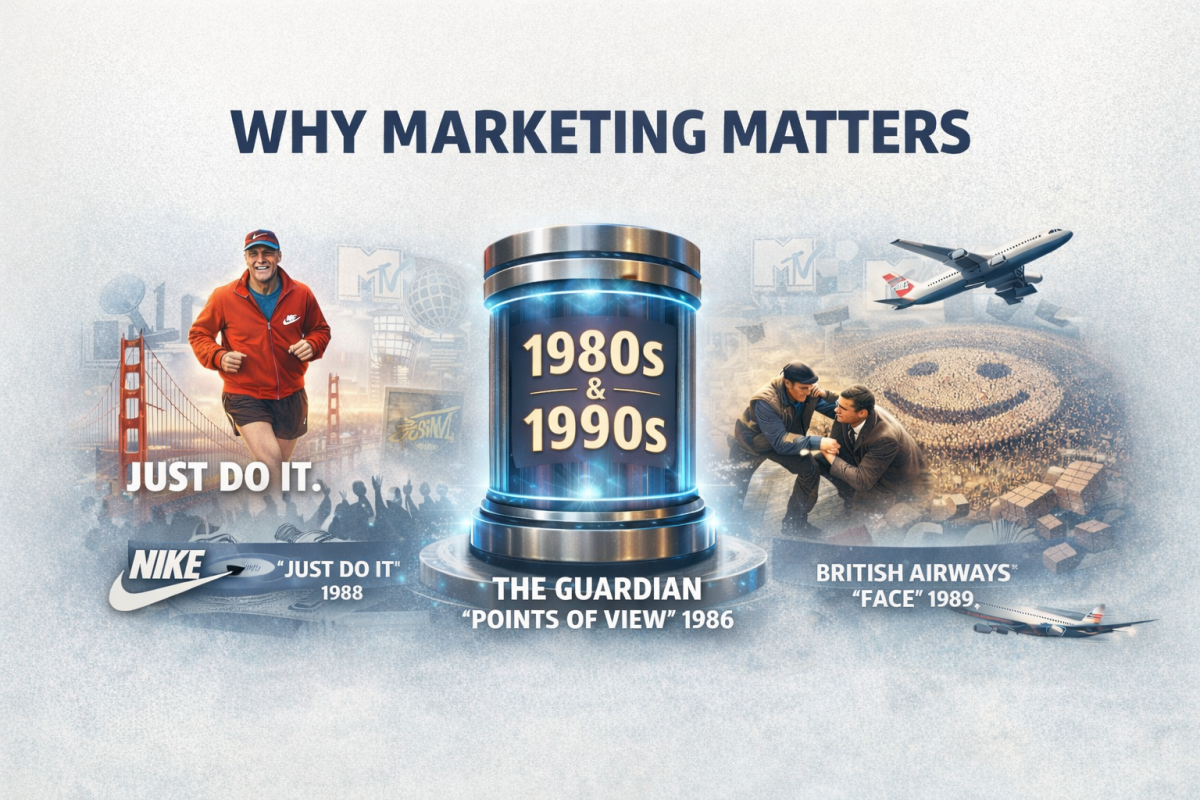
Here are three iconic campaigns chosen by guests at our Global Awards Ceremony that epitomised why marketing matters.
Nike Just Do It, 1988
Nike's Just Do It campaign marked a fundamental shift in brand strategy philosophy; rather than focusing on product features, Nike sold emotion, identity and aspiration.
The first ad featuring 80-year-old Walt Stack running across the Golden Gate Bridge barely mentioned Nike, instead it celebrated determination and personal achievement creating an emotional connection that proved far more powerful than traditional product-focused advertising.
The Just Do It slogan was genius. It was universal (everyone can relate to pushing to their limits) but also personal (we all have our own challenges). It enabled Nike to speak to elite athletes and everyday people, expanding their market reach and creating a new collective identity around determination and self-improvement.
The results were extraordinary: Nike's revenue increased from $877 million to $9.2 billion over ten years, proof that emotionally resonant branding could deliver huge financial returns.
The campaign established the modern sports marketing playbook and proved that successful marketing meant selling meaning, not just merchandise.
The Guardian Points of View, 1986
Perfectly demonstrating why marketing matters through its powerful storytelling that challenged audiences to question their assumptions, these TV adverts brilliantly illustrated bias and the importance of perspective through a simple scenario. The first shot showed a young skinhead appearing to attack a well-dressed man but then the camera shifts and we see the bigger picture - the youth was actually pushing the man out of the way of falling bricks - he was saving him, not robbing him.
"It's only when you see the full picture that you can really understand what's going on," the voiceover concluded.
The campaign proved marketing's power to communicate complex values in seconds. Rather than simply stating "we provide balanced journalism," The Guardian demonstrated this through an experience that made viewers feel the danger of a snap judgment. The ad played on existing prejudices and challenged them, forcing audiences to confront their own biases.
Its lasting impact shows how effective marketing transcends selling products, it can challenge prejudice, shift cultural conversations and build brand identity around meaningful values. The Guardian didn't just advertise, it demonstrated its journalistic principles in a way audiences never forgot.
British Airways Face, 1989
Another milestone campaign, British Airways' Face is a perfect illustration of how a bold creative vision can transform a brand's entire perception and business value.
The ad featured thousands of extras forming a giant smiling face in the desert, accompanied by the voiceover: "Every year the world's favourite airline brings 24 million people together." This spectacular visual became iconic along with the soundtrack and is still cited as one of the greatest ever airline adverts.
The campaign's genius was its timing and emotional positioning. British Airways, privatised in 1987, needed to transform its image from a struggling state-owned entity to a prestigious global brand. It eschewed the traditional airline advertising approach of featuring planes and holidays, focussing entirely on people and human connections, creating an emotional bond with passengers that transcended functional benefits.
The World's Favourite Airline tagline was aspirational and credible, backed up by the factual claim of 24 million annual passengers. This combination of emotional storytelling and proof gave investors and consumers confidence in the brand's global standing.
With a budget exceeding £1 million (huge for the time), the campaign achieved massive exposure across 70 countries, reaching an estimated 600 million people. This investment paid off by successfully repositioning British Airways as a premium, world-class carrier.
The campaign proved that marketing could drive tangible business transformation leading to shifts in brand perception and market value while delivering lasting impact.
What these three campaigns illustrate so brilliantly is marketing's enduring power, the ability to sell meaning over merchandise, challenge assumptions through storytelling and transform brand perception through bold creative vision.
As markets become increasingly saturated and consumers more discerning, these lessons remain vital today; consumers don't buy what you make, they buy what you stand for and how you make them feel.
Read Part 2 here and Part 3 here.
Have you entered The Marketing Society Global Awards for 2026 yet? Find out more here