Navigate: Now & Next returned to Dubai for its fifth edition, bringing together Members and industry leaders to explore how AI is reshaping marketing across the region. From social-first storytelling and agentic operating systems to premium media and the death of the traditional funnel, the day offered a clear message: the brands that build their own AI capability, rather than simply renting it, will be the ones that thrive.
The day opened with Ghadeer El Khub from DCT Abu Dhabi, who took the audience through five ways the destination is using AI across social media. Everything starts with data. A social intelligence centre, built with Ogilvy and WPP Creative Studio, gathers signals from across 27 markets and 14 languages, helping the team spot emerging conversations before they peak. This allowed Abu Dhabi to join the Taylor Swift engagement moment within twenty minutes of the news breaking, and to create a viral Falcon reveal when Drake released an ice sculpture for his new album. The team also built Stan, an AI-generated T-Rex influencer for the Natural History Museum, using Google's VO 3.1 technology. Stan's TikTok channel reached over 300 million views in its first two weeks, with 96% positive sentiment, all without referencing the museum directly. Ghadeer's five takeaways were to listen first and create later, embrace emerging technology, test and learn, turn assets into entertainers, and fuse insight, creativity and technology together.
Hadi Lotfi from Plan.Net Group then set out a wider shift in how brands should operate. He argued that the question is no longer whether someone can create with AI, since everyone has equal access to the same models. The real question is who controls the system: what data it uses, what governance applies, and how decisions get made. He shared six bets for where marketing is heading, including agentic customer journeys, creative supply chains, goal-driven automation, and what he called brand memory, a structured knowledge base covering a brand's products, assets, tone of voice and performance, without which AI will simply guess. His central message was that brands should stop trying to predict the future and instead build their own operating system for it, in house.
Aly Abed, founder of SifNow, shared a more personal story. Frustrated by Dubai's parking shortage, he had an idea for a marketplace matching unused parking spots with people who need them. Without a technical background, he used AI tools including Lovable, Emergent and Claude to build a working prototype himself, something his future team could click through and understand rather than a written brief. This shifted the relationship with developers from weeks of revisions to a shared starting point. SifNow is preparing to launch within the next month or two.
5 Key Points
AI works best when it starts with listening, not creating.
Ghadeer El Khub explained how DCT Abu Dhabi built a social intelligence centre with Ogilvy and WPP Creative Studio, using tools including Talk Walker and AI agents to spot trending conversations early. This let the destination join moments such as Taylor Swift's engagement and Drake's album launch within hours, and helped power the world's first AI dinosaur influencer, Stan, for the Natural History Museum.Brands need their own AI operating system, not just AI tools
Hadi Lotfi argued that everyone now has access to the same AI models, so the real advantage comes from how an organisation governs, orchestrates and connects its agents. He described AI moving from supporting workflows to becoming the workflow itself, built around a brand's own memory of its product catalogue, assets, tone of voice and performance data.Non-technical founders can now build and launch products themselves.
Aly Abed shared how he used AI tools including Lovable, Emergent and Claude to turn his idea for SifNow, a parking marketplace, into a working prototype he could show rather than describe. This let him bring designers and developers into the same picture from day one, cutting weeks out of the development process.AI lets brands move from average customers to truly personalised journeys.
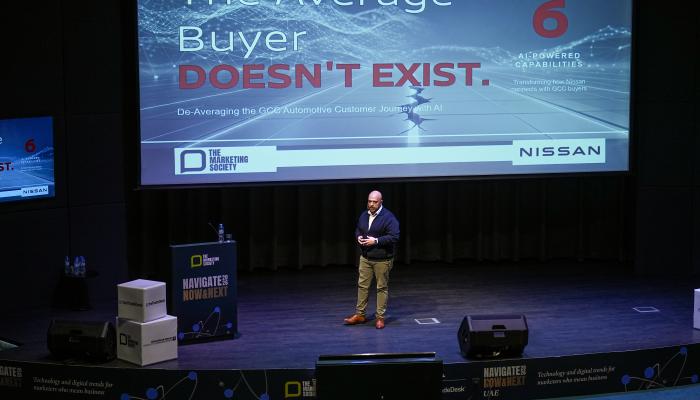
Hossam Al Saeed described how Nissan Middle East uses AI across six experiences, from real-time signals and CGI-generated assets to personalised CRM, to replace one-size-fits-all marketing. The results include a sharp drop in production costs and time, alongside higher qualification rates and faster response times.The traditional marketing funnel is already dead, even if most brands have not noticed.
Serene Haddad argued that discovery, validation, purchase and advocacy now happen in a single loop on social platforms, often driven entirely by creators rather than brand content. Terry Kane added that premium media environments deliver measurably better results, with brand awareness 60% higher and consideration 150% higher on premium sites.After the break, Hossam Al Saeed from Nissan Middle East explained how the brand has moved away from treating customers as an average. Using a framework of create, deliver and optimise, Nissan now uses AI-powered workshops to prepare teams before they even meet, CGI and AI to generate the majority of campaign assets without physical shoots, and real-time signals to personalise everything from ad creative to CRM messages. The results include production costs down by around one sixth, production time down by a third, cost per lead down by at least 10%, qualification rates up by over 15%, and response times to customers down by more than 70%.
Terry Kane from The Trade Desk focused on premium media rather than AI itself. He explained that around 70% of people's time is spent outside social platforms, generating vast numbers of signals across CTV, audio and display. His research found that premium media environments, those with strong brand trust and a natural fit between content and advertising, deliver measurably stronger results: 60% higher brand awareness, 150% higher consideration, and an overall 33% uplift in performance compared with less premium placements. He also highlighted how different generations respond to premium differently, from Gen Z's focus on control to baby boomers' focus on the brand itself.
The day closed with Serene Haddad from Nestlé, who argued that the traditional marketing funnel, moving people from awareness to consideration to purchase, is effectively dead. Today, discovery, validation and purchase can all happen within a single piece of creator content, in a matter of minutes, without the consumer ever leaving the platform. She pointed to Coca-Cola's Share a Coke campaign, which generated over half a billion posts and a 2% sales uplift across more than 80 markets without paid media. Her warning for marketers was that AI will not replace them, but marketers with sharp judgement and a clear, consistent brand signal will replace those who rely on AI for speed alone.
3 Key Takeaways
Build your own brand memory before chasing AI use cases.
Without a structured knowledge base covering your products, assets, tone of voice and performance data, AI tools will guess, and they will guess wrong. Get this foundation right first.Listen to social communities beyond your own channels.
The most successful AI-driven campaigns this year came from spotting conversations happening across the wider web, not just on brand-owned platforms, and moving quickly once a genuine signal appears.Premium environments still matter, even in an AI-first world.
Where your content and advertising appear has a measurable impact on brand awareness, consideration and overall performance, regardless of how that content was created.2 ACTION ITEMS
- Audit your brand's AI readiness. Map your product catalogue, assets, brand guidelines, tone of voice and performance data into a single accessible knowledge base, so any AI tool your team uses is working from the same accurate foundation.
- Run a small, fast AI experiment with a clear non-commercial goal. Following the approach behind Stan the dinosaur, pick one audience you want to build affinity with, give your team the space to test and learn, and judge success by engagement and sentiment rather than immediate sales.
You can view the full insights from all sessions here

“If your brand is not ready for AI, your brand is going to be invisible for AI.”
Hadi Lotfi Managing Director, Plan.Net Group
The Content
Insights from Members
In a world where everyone has AI, what becomes valuable?
Reflecting on Navigate Now and Next Dubai, Noura Haggag argues AI makes execution easy but scales whatever you give it, including poor positioning. As building gets simpler, judgement and market context matter most.
Average Just Became AI. Excellence Didn't
Reflecting on Navigate Now and Next in Dubai, Neda Lazic argues AI makes access easy but not excellence: trust, judgement and storytelling remain the real differentiators, and marketing has always just been matchmaking.
Where is your brand’s AI signal leading to?
AI adoption is no longer in question. Anismita Ghosh writes how Navigate Now and Next Dubai showed having tools is not enough: structure, not technology, decides who turns signals into fast action and who stays stuck theorising.
In Partnership With