
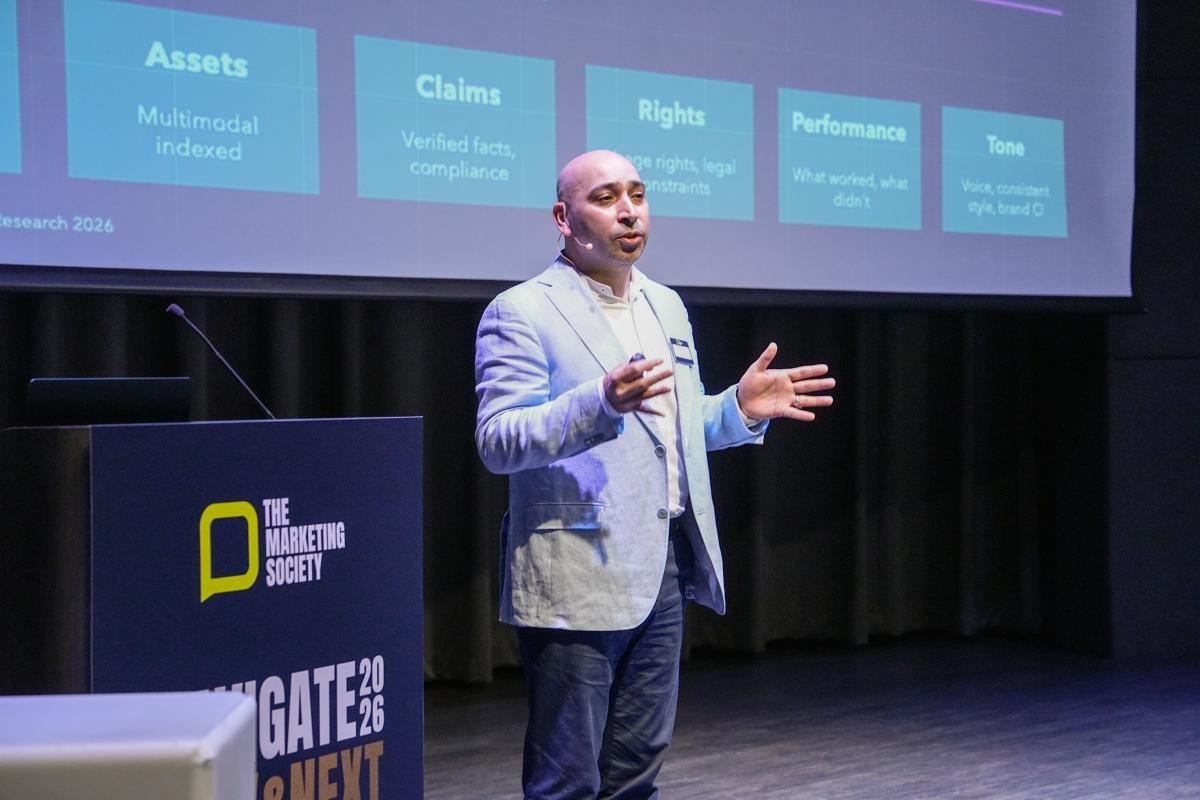
AI is now part of almost every marketing conversation. Most organizations are testing tools and encouraging teams to experiment. That is a good start. But it is not where the real advantage will be created. The next phase will not be defined by who uses the most tools. It will be defined by who builds the strongest operating model around them.
That was the core message of my keynote at The Marketing Society's NAVIGATE: Now & Next 2026 in Dubai, and it is exactly what the latest Serviceplan Group Middle East CMO Barometer confirms:
Not awareness. Not interest. Not ambition. The gap is execution.
Most organizations know what they should be doing. Very few have actually reorganized around it.
Marketing is moving from campaigns to workflows
For years, marketing has been organized around campaigns and assets. A brief is written. A campaign is developed. Assets are produced. Performance is reported. Then the next cycle begins.
AI breaks that loop. It pushes marketing toward connected workflows where insight, strategy, creative, media and learning become one operating loop. The brands that win will not simply create more content faster. They will build systems that make better decisions faster.
Speed alone is not the goal. Better, more connected decision-making is. Those are not the same thing.
Using AI is not the same as operating with AI
The real value starts when AI becomes embedded into how work actually happens: how briefs are written, how insights are used, how creative routes are developed, how media decisions are made, and how performance feeds back into the next cycle.
Most teams are still at the tool stage. They use AI to do individual tasks faster. That is useful. It is not transformative. The winners will not be the teams using AI occasionally. They will be the brands operating with AI consistently.
The next battleground is ownership
As AI becomes more central to marketing, one question becomes critical:
- Who owns the system?
- Who owns the workflows?
- Who owns the data?
- Who owns the brand memory?
- Who owns the governance?
- Who owns the results?
Brands that adopt AI only through disconnected tools risk building dependency without building capability. They may move faster in the short term. They will not create long-term advantage. I have seen this dynamic play out already. Organizations that outsource the intelligence layer entirely will eventually find themselves renting their own marketing back from vendors. The future advantage belongs to organizations that control their own intelligence layer. The strategic context, brand knowledge, workflow logic and governance model need to belong to the organization.
Brand memory needs to become machine-readable
AI agents need more than prompts. They need structured brand truth: positioning, tone of voice, approved claims, legal boundaries, asset rights, customer context and performance history. Today, most of this still lives in PDFs, folders and people's heads. Ask yourself honestly: if a new AI agent joined your marketing team tomorrow, how long would it take to brief it properly? Weeks. Months. Maybe never.
Machine-readable brand memory is not a technical nice-to-have. It will become one of the most important strategic assets a brand owns.
Creative and media need to become one loop
In many organizations, creative and media still run in separate tracks. They meet at key moments but are not connected throughout. That separation made sense when campaigns were the unit of work. It makes much less sense when the unit of work is a continuous, signal-driven workflow.
AI makes it possible to connect them: market signals, audience insights, creative routes and performance data flowing through one shared system. Creative teams work with better context. Media teams activate with stronger relevance. The result is not just efficiency. It is a more adaptive organization.
Control comes before autonomy
Agentic AI will increase automation. But autonomy cannot be the starting point. Before brands give AI more responsibility, they need the right foundations: trusted data, clear workflows, approval gates and measurable outcomes. This is where many organizations will get it wrong. Autonomy is being positioned as the goal. But if the foundations are not right, more autonomy just means faster mistakes at greater scale.
The progression needs to be deliberate: First, AI suggests. Then it recommends. Then it drafts. Then it executes with approval. Only then does it act with more autonomy in clearly defined areas. Trust is built in that order. Not faster.
From experimentation to operating model
The Middle East is moving fast and marketing leaders here are among the most open to transformation I have encountered anywhere. But ambition is not enough. The next phase requires identifying where AI creates real value, connecting data, creativity, media and governance, and building the internal capability to operate these systems responsibly.
- From tools to workflows.
- From pilots to operating models.
- From isolated assistants to connected intelligence.
- From productivity gains to business impact.
The campaign era is not ending gradually. It is ending now. The organizations that recognize this early enough will not just be more efficient. They will be operating a fundamentally different kind of marketing machine.
The question is not whether AI will reshape marketing. It will. The real question is whether brands will own the operating model behind it or find themselves renting it.