We ran an Oxford Union-style debate in Singapore on the motion: "Media plans all look the same now." It was over-subscribed. At the end, the majority said they will rethink their media mix. We didn’t know if this would resonate. It’s creating a movement.
When The Marketing Society Singapore asked me to run an Uncomfortable Conversations session, I had one worry: what if nobody cared about the topic as much as I did? The topic was media planning – the thing I have done for the last 25 years. Specifically, the question I wanted to explore was why media plans have converged so dramatically into a handful of digital platforms - and whether that convergence is a rational market outcome or a slow-motion problem the industry has been reluctant to name.
We had 100 RSVPs. The room was full. Maybe people did care?
The format: a real debate, not a panel
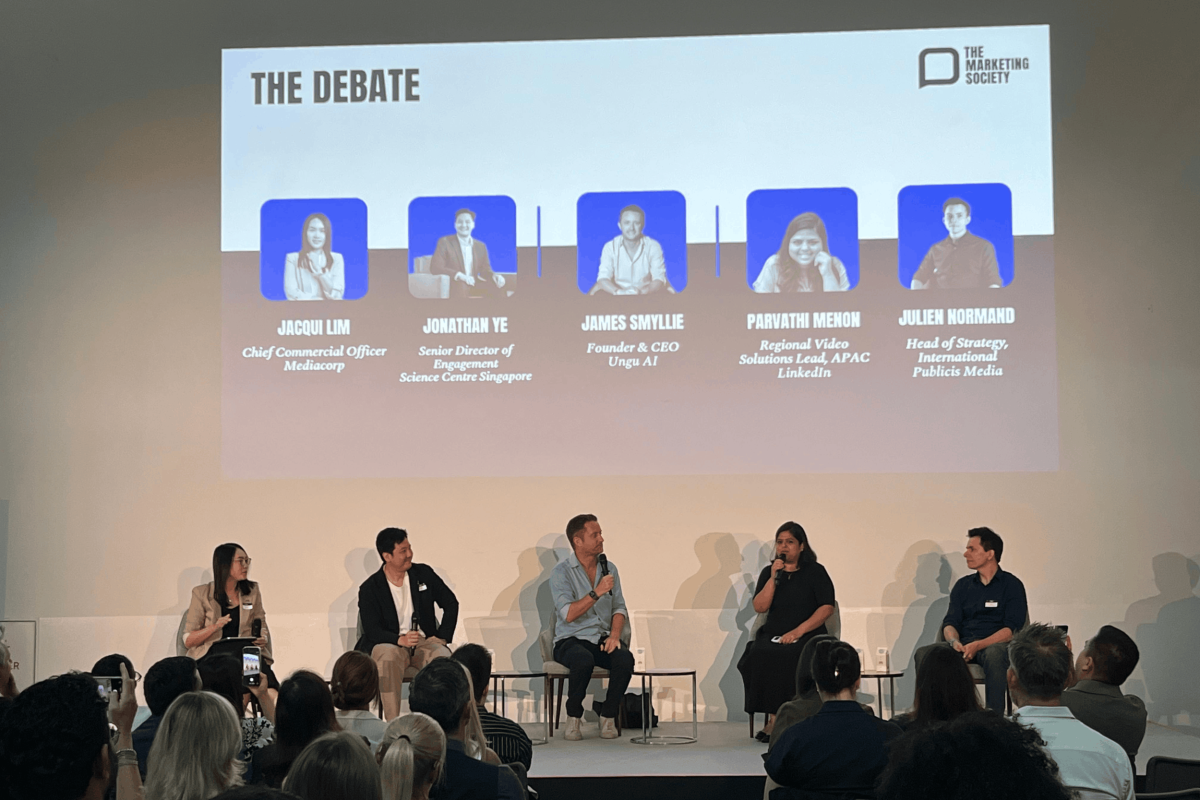
Rather than a traditional panel where speakers agree with each other politely, we ran an Oxford Union-style debate. The motion: "Media plans all look the same now", four senior practitioners - two arguing for, two against - each given seven minutes, alternating, with twelve minutes of audience Q&A to close.
Arguing for the motion: Jacqui Lim, CCO at Mediacorp, and Jonathan Ye, a marketing client veteran. Against: Julien Normand, Head of Strategy at Publicis Media, and Parvathi Menon, formerly 18 years at Google and now at LinkedIn.
The guidance was simple: argue your position with conviction. No hedging, no nodding at the other side mid-speech.
The data that set the scene
Before handing over to the debaters, I presented 15 minutes of context. The number that landed hardest: court filings from the WPP whistleblower case (Foster v. WPP plc, New York Supreme Court, 2025) showed that 89% of WPP Media's tracked global platform spend went to just five companies - Google, Meta, Amazon, TikTok and The Trade Desk. That number came from internal data, placed into the public record by WPP themselves in their defence filing. It’s fact. It’s a legal disclosure.
The counterpoint was equally stark: Analytic Partners research shows that five-channel campaigns deliver 77% better ROI than single-channel ones. Val Morgan research shows one cinema ad generates the same brand fame as ten digital ads. The cost of concentration is measurable.
The lines that stayed in the room
The debate produced several moments worth sitting with.
- "Don't blame the ingredients, blame the cook. Too many planners see performance as the single and only metric."
- "As agencies, there is no conspiracy to prioritise a few social platforms. We push for diversity, but often need more data and accountability from mainstream channels."
- "I look at media plans and... I am bored by what I see."
And from an audience member - a senior agency leader - the comment that cut through everything else: "My 19-year-old son with no income sees all the ads. I am 48, with spending power, and I don't see any." Scott Spirit, S4 Capital
Why the room cared
The honest answer to why this topic resonated is that it sits at the intersection of three problems the industry knows exist but rarely discusses together:
- Imperfect measurement that favours easily tracked digital channels
- Agency incentive structures where the margin on digital can be significantly higher than on channels like TV
- The slow atrophy of media planning skills as a generation of planners has come up without ever building a full-channel plan.
None of these is a conspiracy but all of them are structural. And the combination produces plans that look the same - not because planners lack curiosity, but because the system rewards a particular kind of efficiency over a broader kind of effectiveness.
What happened next
At the end of the session, I asked one question: will you rethink your media mix off the back of this morning? Most hands went up. Within 24 hours, a group of senior marketers had volunteered to form a council to take the conversation further. The conversation the industry had been avoiding is now, it seems, one that we are ready to have.
3 Takeaways
Concentration is documented, not theoretical
WPP's own court filings show 89% of tracked platform spend going to five companies. The data exists. The industry just does not talk about it.The cost of sameness is measurable.
Analytic Partners, Val Morgan and Ebiquity research all point in the same direction: diverse channel mixes outperform concentrated ones on ROI, attention and brand fame. The case for diversity is evidence-based, not nostalgic.The appetite for change is real.
One hundred senior marketers RSVPd for a breakfast debate on media planning. Most hands went up when asked if they would do something differently. The audience is ahead of the system.2 action items for media planners
Pull your last three media plans
Calculate what percentage of spend went to Google, Meta and TikTok combined. If it is above 70%, ask whether that reflects your audience's attention or your agency's defaults.Commission or request a cross-channel attention study
Do it before your next planning cycle. Cost efficiency and attention efficiency are not the same thing. A cheap impression nobody notices is more wasteful than an expensive one that lands.
"Not everything that counts can be counted."
James Smyllie Founder and CEO of Ungu