Five sessions at Navigate: Now & Next 2026 Singapore delivered the same uncomfortable conclusion from five different angles: the bottleneck in marketing is no longer technology. It is us. With AI getting dramatically better at the things we do, the question for senior marketers is whether we are getting better at the things it can't. This piece unpacks the key insights, lightbulb moments, and practical actions from a morning that challenged the room to stop upgrading their tools and start upgrading themselves.
"AI won't replace humans." I heard this reassuring message five times in one morning. Comforting for sure but maybe beside the point.
Every session pointed in the same direction. Not one speaker suggested we slow down. Not one said the answer was more tools. The signal was unmistakable: the bottleneck has moved and it is no longer technological. It is human. It is time for a Human Upgrade.
5 Key Points
The CMO's real enemy is internal, not external
The biggest drag on growth isn't fragmented media or missing tech, it's fragmented decision-making inside your own organisation. The CMOs winning are the ones building trust across functions, not just optimising within their own silo. They nuance short-term gain with long-term investment, they think ‘win’ and ‘trade-off’.Your org chart is your speed limit
The ability to learn, ship and iterate faster than the market is now the only sustainable advantage. Rigid approval processes and fixed operating models are a bigger threat than any competitor. Culture eats technology for breakfast: curiosity and adaptability matter more than credentials.Feeds are the new storefronts
If your brand isn't showing up where decisions happen, you're not being considered. You don't compete with other brands for attention, you compete with everything in the feed. Scalable content systems beat hero campaigns; showing up daily beats showing up perfectly.AI is the orchestra. You're the conductor
AI is the orchestra. You're the conductor. The value of AI isn't cost reduction, it is faster learning cycles and real-time adaptation. Connected systems (not isolated tools) are where the competitive advantage lives. The more you automate, the more valuable your judgement, taste and emotional intelligence become.The democratisation of creation is complete
What once required teams and budgets now requires only ideas and speed. Startups are solving real marketing problems faster than enterprise procurement can approve a vendor.More Data, Less Clarity
The CMO Tension panel (Alvin Neo from FairPrice Group, Lex Bradshaw-Zanger from L'Oréal, moderated by Olivier Kuziner from Ekimetrics) coined what most leaders feel but won't say out loud: more data has not created better decisions. It has created more confusion dressed up as strategy. Siloed teams, overloaded KPIs, short-term pressure colliding with long-term brand ambition. The challenge is no longer technology itself, it is organisational clarity, judgment and decision-making. Alvin and Lex agreed on one thing: "Sales overnight, brand over time." Nailing both the "what's right" and the "what's right now" is easier said than done, especially when the CFO wants sales attribution by Wednesday.
The Moat Has Moved
Walter de Oude (Chocolate Finance) made the case that AI is democratising creation. A small team with AI can now outproduce a department ten times its size. Not in polish but in relevance, in speed to market, in willingness to ship without a 14-slide approval deck. Budget or headcount is no longer a moat. The new competitive advantage is whether your organisation can learn faster than the market moves. Most large structures aren't geared to do this yet; everyone in the room seemed to recognise it.
The Feed Is the Shelf
Melissa Laurie (Oysterly Media) showed how discovery has shifted from search bars to social feeds. Social and short video platforms aren't entertainment with discovery features; they are the discovery infrastructure. In feed-based environments, your competitor isn't the brand next to you on the shelf. It's every piece of content fighting for the same three seconds of attention. The old playbook (one polished campaign launched with fanfare) is losing to something messier and more effective: continuous creation, diversified creative, creator authenticity, and presence over perfection.
Speed Without Soul Means Nothing
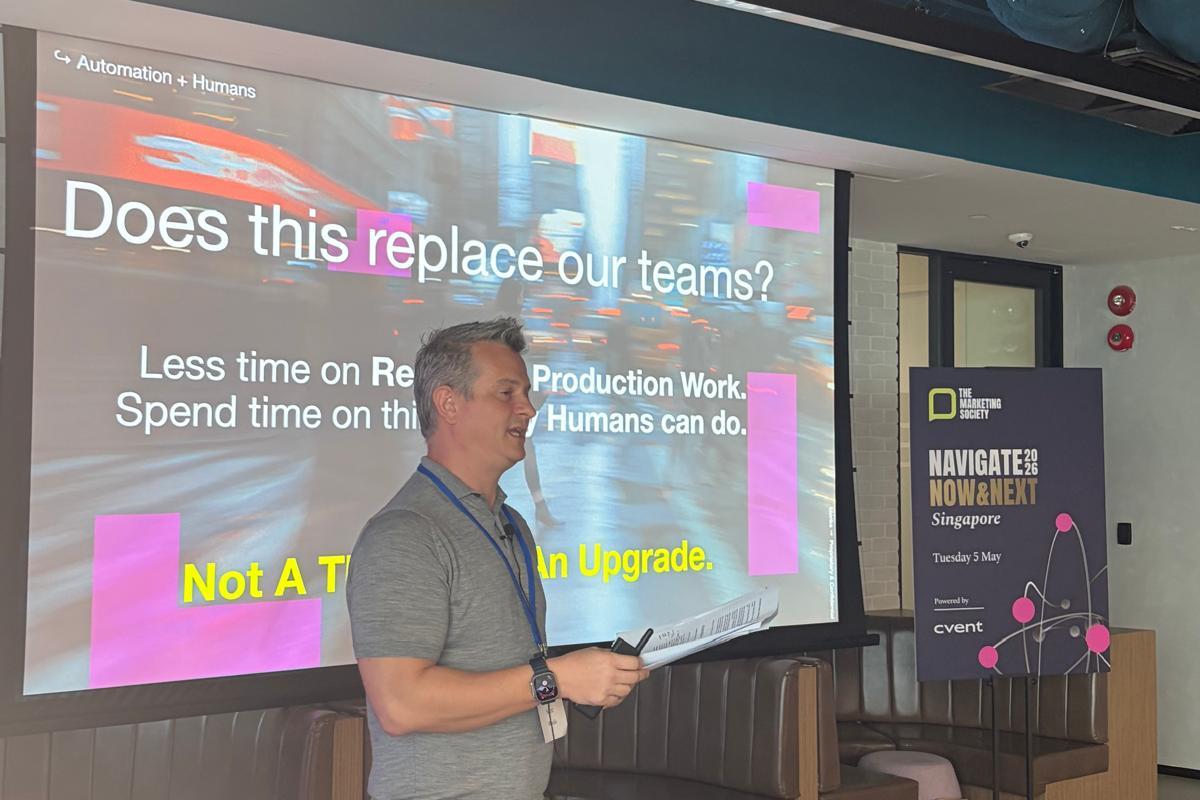
Scott Spirit (S4 Capital | Monks) brought some technical clarity: connected systems operating as one adaptive ecosystem. AI enables speed but here's the pattern that became impossible to ignore. AI accelerates workflows, it does not generate vision. AI recommends the next best action, it can't imagine it. AI produces thousands of variations, it does not feel which one connects. Every capability AI absorbs creates a new surface area where human skill becomes the differentiator.
The Barriers Have Collapsed
Four startups (ShiftRight, GoodBards, Wubble, HeyMax) confirmed it with proof: marketing plans built in minutes, AI-led B2B LeadGen, ethical AI music production, loyalty re-imagined. What used to take your team a quarter now takes someone else an afternoon. The barriers to creation have collapsed. The question is no longer whether AI will transform marketing, it already has. The question is how will you transform?
3 Takeaways
Clarity beats complexity
The future won't belong to who has the most tools. It will belong to organisations that simplify decision-making, align teams around shared outcomes, and combine automation with deep human understanding and intervention.Presence beats perfection
In a world of algorithmic feeds and continuous content, of fragmentation and constant change, showing up consistently and authentically matters more than showing up flawlessly once a quarter.Time for a "human upgrade
The marketers who will thrive are not the ones who adopted AI first. They are the ones who intentionally upgraded themselves to match what AI makes possible. Call it vision or judgement, presence or warmth, it is the work that remains when the machine handles everything else. These aren't soft skills, they're the hard ones now.2 Action Items
Audit your decision speed, not your tech stack
Map how long it takes a creative idea to go from brief to live. If the answer is measured in weeks, your problem isn't tools, it's organisational design.Invest in the human layer too
Identify the capabilities in your team that AI cannot replicate: strategic synthesis, relationship depth, creative courage. Deliberately build them. Treat your own upgrade as seriously as your technology's.
"The tension between pressure for growth and execution is the frame, not the picture."
Lex Bradshaw-Zanger, Chief Marketing & Digital Officer SAPMENA L'Oréal Groupe