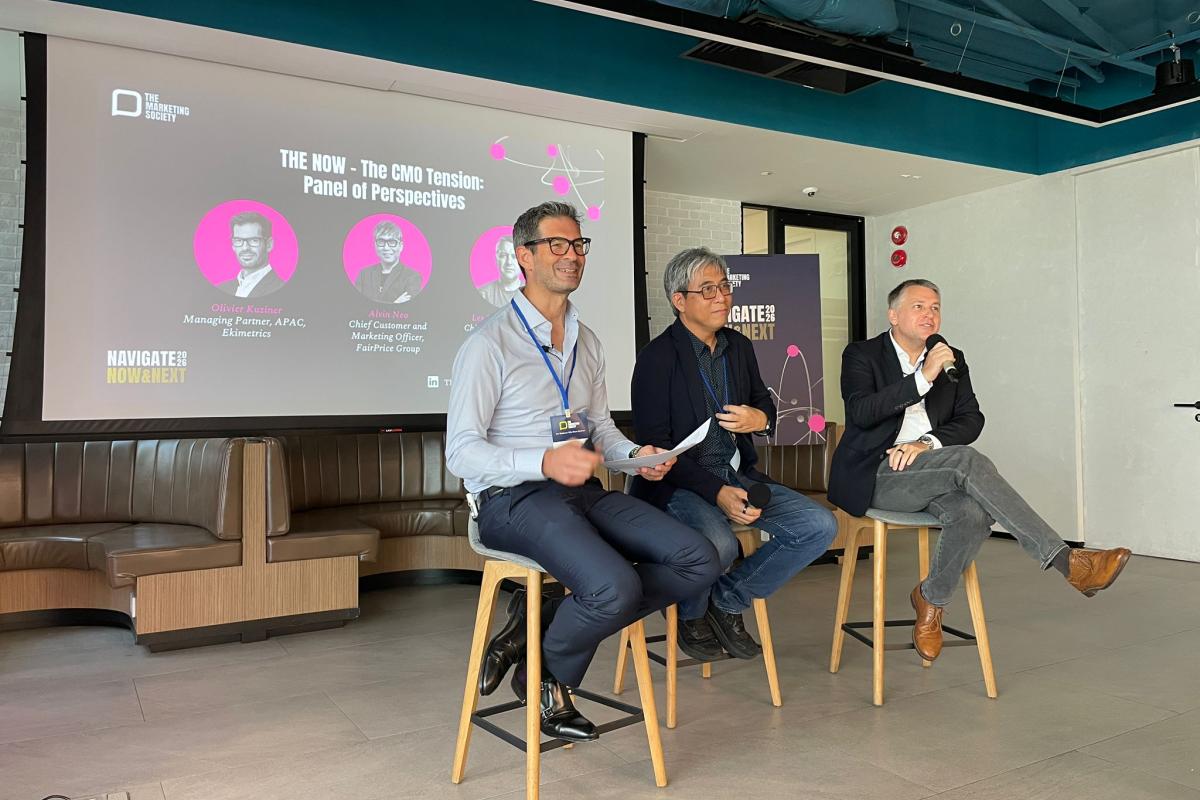
Marketing has never had more to work with. More data, more channels, more technology, more ways to reach people at precisely the right moment with precisely the right message. And yet, sitting in a room full of some of the sharpest marketing minds in Asia at Navigate: Now & Next 2026 Singapore, the question that kept surfacing was not about any of those things. It kept coming back to something deeper: how marketing organisations are actually designed to use what they already have.
The Marketing Society brought together senior marketers, founders, technologists and growth leaders to explore what is genuinely shifting beneath the AI conversation. What emerged was a picture that felt both more urgent and more human than much of the current discourse suggests. Capability still matters. But the operating structures, workflows and decision-making architecture around it determine whether capability translates into action at all.
5 Key Points
Sequence is everything
Foundations before AI: data, process, organisation design. Get it right and AI multiplies impact. Skip it and AI multiplies problems.The ambition-execution gap is structural
Not talent. Not budget. Design. Naming it correctly changes where organisations focus.One brief. Thousands of outputs
Always-on orchestration is not an incremental upgrade to old structures. It is a different operating model entirely.Adaptability is designed in, not bolted on
Governance and decision rights should make responsiveness the default, not the exception.Human judgement is the scarce resource
As automation rises, cultural intelligence and creative instinct compound. Design systems that concentrate them where they matter most.AI is not exposing a capability gap in marketing organisations. It is exposing an architecture gap.
Most marketing functions were designed for a world that no longer exists, and the evidence of that mismatch is accumulating faster than most organisations can comfortably absorb. Google's search share fell for the first time in a decade. Brands with connected AI operating models are responding to market opportunities eight times faster than those without. AI is projected to add 4.7 trillion dollars to global marketing value by 2030, but that value will not be distributed evenly across the industry. It compounds toward the organisations that figure out orchestration first, while everyone else effectively funds the gap.
Which brings us to the question that actually matters: how do marketing teams get back in the driver's seat, with the architecture to connect every lever of growth and the confidence to pull them? It was that question, more than any other, that shaped the brief when helping build the agenda for The Marketing Society's Navigate: Now and Next event in Singapore. The goal was straightforward: skip the hype, bring in leaders who are genuinely navigating this moment, and surface what is shifting and what it demands of the people responsible for growth.
You cannot build on a broken foundation
In my mind, the most compelling insight from the day was deceptively simple: advanced AI cannot scale on fractured foundations. The sequence matters.
Three things must come before AI investment
Get these right and AI multiplies impact. Skip them and AI multiplies friction and cost.
Clean, unified, trustworthy data infrastructure
Simplified processes, not digitised versions of old ones
Organisation design that reflects how work must flow today
Marketing fundamentals are becoming even more valuable
The highest-value human contributions, judgement, creative instinct, cultural intelligence and emotional insight, become more critical as automation handles the repeatable.
The best marketers will not just survive this transition. They will define it.
Upskilling now means two things in parallel: deepening the human craft of marketing and building the capability to work effectively alongside AI. Neither alone is sufficient.
As Allen Cai, CMO Greater China at Nestlé, observed in the CMO Tension research:
“Use AI to free your team to pursue the irrational, the subconscious and the emotional cues that create genuine connection.”
That is not a consolation for human marketers. It is the point of marketing to humans.
Discovery has moved. Most planning has not
Melissa Laurie, CEO and Founder of Oysterly Media, shared data that recalibrates the picture yet again. Nearly one in four TikTok users searches within 30 seconds of opening the app. Half of all Instagram time is spent in Reels. AI-powered search is compressing consideration to purchase into a single real-time interaction.
Discovery is no longer episodic. It is ambient, algorithmic and immediate.
The brands pulling ahead have shortened the insight-to-activation loop to hours, not weeks. That is not a creative upgrade. It is a function redesign.

“The tension between pressure for growth and execution is the frame, not the picture.”
Lex Bradshaw-Zanger, Chief Marketing & Digital Officer SAPMENA, L’Oréal Groupe
One brief. Thousands of outputs. A completely different way of working.
Most marketing leaders already understand Agile ways of working: cross-functional teams, sprint delivery, faster loops. Those models produced real gains.
What AI adds is a different dimension entirely. Not dozens of content variants from a sprint. Thousands.
Scott Spirit, Chief Growth Officer at Monks, brought this to life through the Google Fi case. Under 1% brand awareness. Operating architecture rebuilt. Brand-led campaign delivered in six weeks. 16% growth in sign-ups against the control group.
The creative was strong. The AI-powered content engine made it hyper- scalable.
“Data without speed is just history. You cannot win tomorrow’s battle with last month’s map.”
— Scott Spirit, Chief Growth Officer, Monks
To enable this way of working, organisations need architecture that pulls AI, agencies, partners and internal teams into one connected operating model moving at speed together.
The hardest part is not the technology
In most organisations, the real constraint is this: nobody has been given explicit authority to redesign how the function works as each new wave of transformation arrives.
Digital transformation gave us new channels. Data transformation gave us dashboards. Content transformation gave us more to publish. AI is now giving us tools that can do all of it faster.
The tools keep evolving. Most operating models have not.
So the gap between what organisations know and what they can act on, coherently, at speed, in real time, continues to widen.
The organisations making progress are designing adaptability in from the start. Building teams as pods with the governance, decision rights and autonomy to respond in real time. Change becomes the operating condition, not the disruption.
The Architecture Challenge
SOBO. Not a new idea. But a precise one.
How do you design a marketing function that delivers performance speed, brand depth and commercial rigour simultaneously?
The answer is not another tool or a bigger budget. It is how we design our teams and workflows.
This is the architecture challenge. Designing marketing systems that can compound brand over time while responding commercially in real time.
How might we architect a connected operating model where data, content, media and purchase operate as one loop, with AI handling volume and speed, and human judgement concentrated where it compounds most?

“SOBO. Sales Overnight. Brand Over time.”
Alvin Neo, Chief Customer and Marketing Officer FairPrice Group
The most important decisions are not about tools
The next competitive advantage in marketing will not come from access to better technology. Most organisations already have access to the same tools.
The advantage will come from decision velocity: how quickly a function can turn a real-time signal into coordinated action across data, content, media and purchase.
Most marketing functions are still structured for delay.
The organisations redesigning now are not just moving faster. They are making it structurally harder for everyone else to catch up.