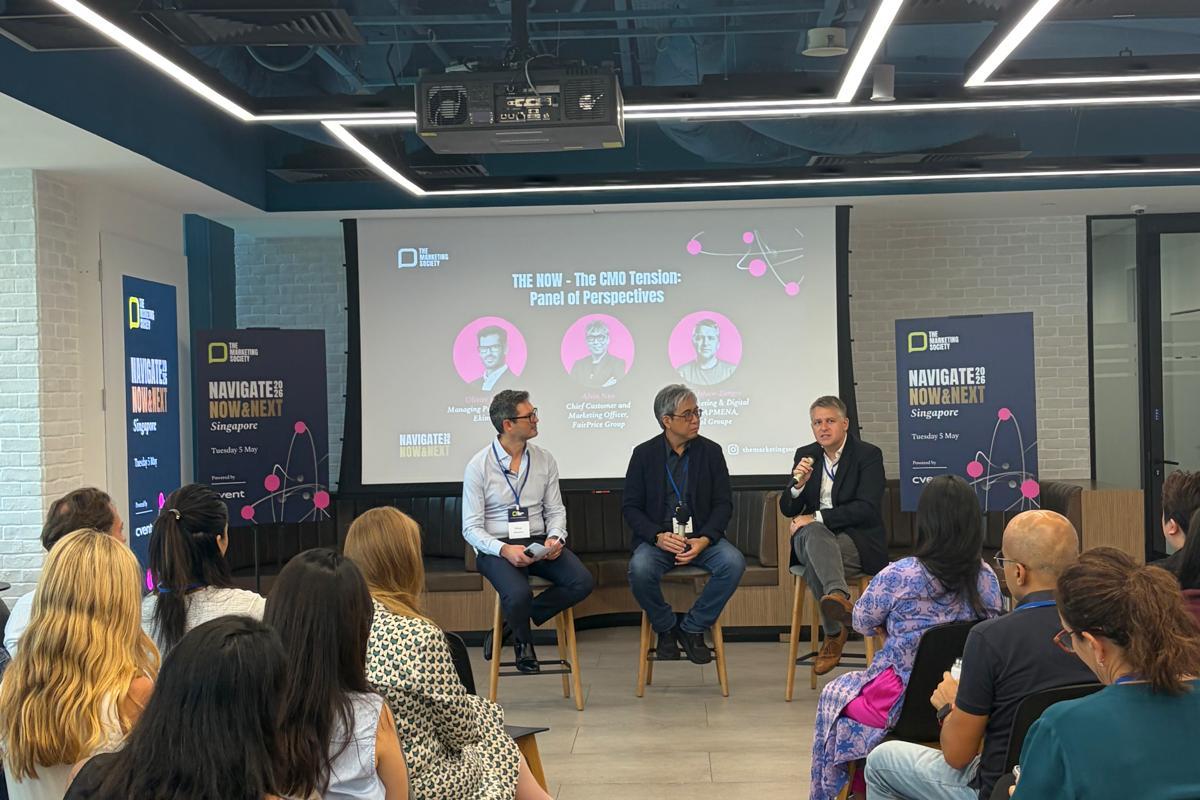
At Navigate: Now & Next 2026 Singapore, The Marketing Society brought together senior marketers, founders, technologists and growth leaders to explore one of the biggest questions facing the industry today: how do marketers lead when everything around them is changing at once?
Across the morning, one thing became clear. The future of marketing will not be won by the companies with the most tools, the most dashboards, or the most AI pilots. It will be won by organisations that can bring clarity to complexity, connect technology to business outcomes, and keep human understanding at the centre of growth.
5 Key Points
The biggest barriers are internal, not external
Siloed teams, misaligned KPIs and disconnected measurement are holding brands back as much as any external disruption. Fixing internal complexity — clearer decision frameworks, better cross-functional alignment — will unlock more growth than another technology investment.AI is a workflow revolution, not a replacement for human judgement
AI can accelerate execution, compress timelines and scale content production. But strategy, creativity, cultural understanding and emotional insight remain irreducibly human responsibilities. Organisations that conflate speed with intelligence will fall behind those that combine both.Discovery has moved into the feed
TikTok, Instagram, creators and short-form video have become primary discovery environments. Brands must rethink how they show up before consumers actively search, investing in always-on, platform-native content that is authentic, useful and consistently present.Growth belongs to the whole organisation
Product, operations, technology, customer experience and leadership all shape how a brand grows. Marketing cannot carry it alone. The most resilient growth strategies are built across functions, with shared accountability and a shared definition of what winning looks like.Clarity may be the next competitive advantage
In a world of noise, tools and data overload, the brands that win will be those that simplify choices, align teams and act with confidence. The marketer’s job is no longer just to produce — it is to orchestrate clarity across an increasingly complex system.The opening session set the tone
Marketing fundamentals have not disappeared — brands still need to create demand, build memory structures and convert that demand into growth. What has changed is the operating environment. Media is fragmented. Data is overwhelming. Consumer expectations are rising. AI is accelerating. And within organisations, accountability is often unclear. The key insight was simple: this is not a technology problem. It is a decision problem. Many of the biggest barriers are internal — siloed teams, fragmented KPIs, disconnected measurement and competing definitions of success. More data has not automatically created better decisions; in many cases it has created more debate, more dashboards and less clarity. Future-ready organisations will need clearer strategic frameworks, better alignment across functions and measurement systems that genuinely connect marketing activity to business outcomes.
The CEO conversation widened the lens
The examples of Singlife and Chocolate Finance showed that growth starts by solving a real customer problem. Brand is not only what a company says in advertising — it is the ease of opening an account, the simplicity of a product and the trust built through experience. That is a hard but necessary reminder for marketers. Growth cannot sit in a marketing silo. Product, technology, operations, customer experience and leadership all shape how customers experience a brand. In an AI-shaped world, curiosity, adaptability and the ability to learn may matter more than credentials alone. The companies that win will be those that build cultures of experimentation, not cultures trapped by process.
The sharpest behavioural shift of the morning was the migration of discovery from search engines to social platforms
Google is no longer the only default gateway. Consumers increasingly find products, places and ideas through TikTok, Instagram, creators, short-form video and communities. Discovery is becoming more visual, emotional and immediate — people want to see how something feels, how others use it and whether it fits into their world. For brands, this changes the content model entirely. The traditional ‘one big campaign’ approach is not enough. Brands need always-on content engines that can test, learn and respond quickly. Authenticity matters more than polish, and creator-style content often travels further than over-produced advertising.
The conversation then moved from content into operating model
The next advantage in marketing will not come from isolated AI tools — it will come from connected systems where data, media, content and performance work together in real time. AI does not remove the need for human creativity; it changes where human effort should go. Strategy, brand judgement, emotional storytelling and cultural understanding remain human responsibilities. AI can accelerate production, adaptation and optimisation, but the bigger barrier is organisational change. Approval processes, workflows, team structures and mindsets must evolve. A company cannot operate with yesterday’s structures and expect tomorrow’s speed.
The startup showcase brought the future down to earth
ShiftRight, GoodBards, Wubble and HeyMax demonstrated how technology is already being embedded into marketing workflows, sales prospecting, content creation and loyalty ecosystems. The common theme was simplification. AI can now compress tasks that once took weeks into minutes. At the same time, responsible innovation and emotional value will matter — speed alone is not enough. Trust, ethics and customer relevance will separate serious solutions from short-term gimmicks. Marketing innovation is no longer waiting for large organisations to move. Startups are building around pain points faster than many enterprises can restructure.
3 Takeaways
Audit where complexity is slowing growth
Look at your organisation honestly. Where are decisions delayed? Where are KPIs misaligned? Where is data creating debate rather than action? Internal friction — not a lack of tools — is often what holds brands back. Resolving it may be the highest-return investment a marketing leader can make.Build a discovery and content engine, not just a campaign plan
Map where your consumers now discover, evaluate and decide. Then build a content system that can show up consistently across those moments with useful, authentic, platform-native content. One-off hero campaigns are no longer enough — the brands that win will be those that are always, credibly present.Lead with human judgement, accelerated by AI
Embrace AI to compress timelines and scale execution, but keep strategic and creative judgement at the centre. The marketers who will lead in the next chapter are not those who automate the most — they are those who use automation to free themselves for the thinking that machines cannot replace.2 Action Items
Reduce Internal Complexity
Simplify internal decision-making by aligning teams, KPIs, and measurement frameworks around shared business outcomes rather than fragmented performance metrics.Rethink Discovery & Content
Build an always-on discovery strategy that combines AI-enabled speed with authentic, human-led content designed for how consumers now discover brands across social platforms and creator ecosystems.
“This is not a technology problem. It is a decision problem. More data has not automatically created better decisions — in many cases, it has created more debate, more dashboards and less clarity.”
Olivier Kuziner Ekimetrics