
Most conversations about AI culture start with psychological safety, but new research suggests it’s already there. The real gaps are in what organisations do with it. In the fourth article of The Red Pill Series, humari’s Joe Hildebrand explores what’s really blocking marketing teams from getting real value from AI - and it isn’t always fear.
When we set out to measure human AI readiness across 510 UK professionals for humari’s first annual Human AI Readiness Report, we expected psychological safety to be the weakest link. Every client conversation, every conference panel and every thought piece on AI culture points to the same thing: people don’t feel safe enough to experiment, fail and learn. Build the safety and the rest follows. The data told us we were off the mark.
The surprise in the data
Psychological safety scored 58 out of 100. Whilst not a particularly high number in itself, it is the highest of all eight dimensions we measured. Relative to other dimensions, people feel comfortable admitting they don’t understand AI tools, teams openly discuss concerns without fear of being seen as resistant, and managers respond to questions with curiosity rather than impatience. The safety is already there.
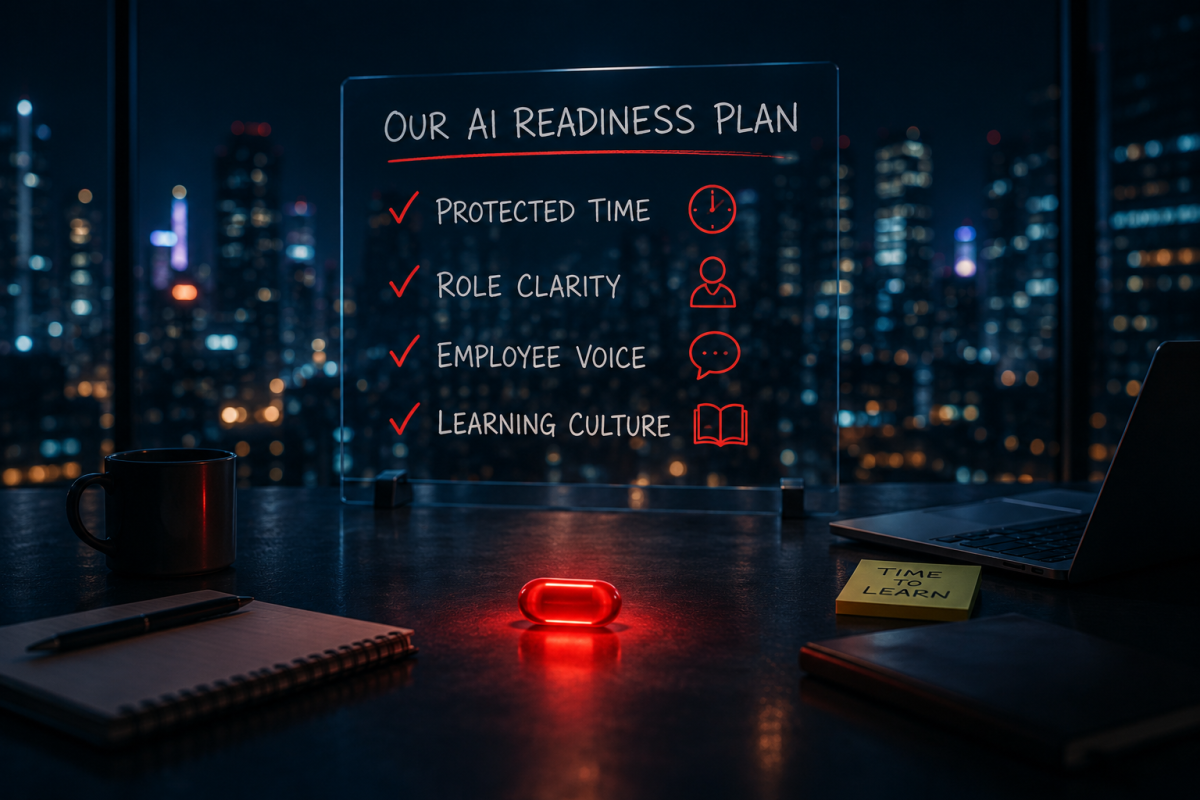
What isn’t there is everything the organisation is supposed to do with it. Protected time to explore AI scored just 39, the second lowest in the entire study. Understanding of how their own role will change scored 35, the lowest of all twenty-four questions, with 59% of respondents disagreeing that they had any clear picture. Learning culture, the dimension that captures whether experimentation is valued as much as delivery, sat at 43. Employee voice and inclusion, whether people have a genuine say in AI decisions, scored 43. The pattern is consistent: the willingness to engage is already there, the organisational follow-through is not.
The view from the top doesn’t match the view from the ground
This gap is invisible to most leaders because they’re systematically more optimistic about readiness than their teams. In our data, leaders rated readiness higher than individual contributors on every single dimension and the divergence was statistically significant on the three most personal ones: whether people’s professional identity feels secure, whether they can absorb more change, and whether the AI narrative actually reaches them.
Jasper’s 2026 State of AI in Marketing report, surveying 1,400 marketers, found the same pattern in sharper relief: 61% of CMOs say they can prove AI ROI, compared with just 12% of individual contributors. 85% of CMOs say AI has increased job satisfaction, versus 56% of ICs. For marketing leaders specifically, this should be a red flag: the people closest to the work see a fundamentally different reality to the people setting the strategy.
The most effective teams build the right conditions
The organisations in our study that scored highest on readiness didn’t have fundamentally different people, they had fundamentally different conditions. Training alone created a 45-point readiness swing, from a score of 30 for those with no AI training to 75 for those with extensive training. That gap is more than three times wider than anything produced by industry, function, company size, age or gender. Readiness, it turns out, is built, not inherited.
Jasper’s research reinforces this. Marketing teams with clear structure, governance and ownership around AI report dramatically higher job satisfaction (66% at advanced organisations versus 15% at beginner ones) and significantly stronger ROI confidence. The same technology, the same disruption, produces completely different human outcomes depending on the conditions the organisation builds around it.
What this means for marketing leaders
The red pill here isn’t always about creating psychological safety from scratch. For many teams, it’s about recognising the safety that already exists and building the organisational conditions to use it: protected time to learn, a clear and personal narrative about how roles will evolve, genuine input into AI decisions, and a learning culture that treats experimentation as seriously as delivery. These aren’t soft investments; they’re the conditions that determine whether your AI spend produces returns or just activity.
3 Take aways
Psychological safety isn’t the blocker most people assume
In a study of 510 UK professionals, it scored highest of all eight readiness dimensions. The appetite to engage with AI is real, but what’s missing is the organisational follow-through.Leaders are systematically more optimistic than their teams
The perception gap is widest on the most personal dimensions: identity, change capacity and narrative. CMOs who assume their teams feel the same way they do are almost certainly wrong.Readiness is built, not inherited
Training creates a 45-point readiness swing, more than three times the impact of industry, function or demographics. The most effective teams don’t have better people, they have better conditions.2 Action Items
Measure what your team experiences, not what you assume
Run a short, anonymous pulse across your marketing function asking three questions: do you understand how your role will change with AI? Do you get protected time to explore AI tools? Do you have genuine input into AI decisions? If the scores are low, that’s your roadmap.Protect time to learn, visibly and formally
The second-lowest score in the entire study was whether people get dedicated time and resources to explore AI. Block it in calendars, name it explicitly, and make it as non-negotiable as campaign deadlines. Experimentation that competes with delivery will always lose.
“The willingness to engage with AI is already there. What’s missing is the organisational follow-through: the time, the story and the voice. That gap won’t close on its own. It has to be built.”
Joe Hildebrand humari
Sources
- Psychological safety highest dimension (58/100) / protected time to learn (39) / role change understanding (35, lowest of 24) / learning culture (43) / employee voice (43) / 45-point training swing / leader-IC perception gap statistically significant on identity, change readiness and narrative: humari, “The Readiness Paradox: 2026 Human AI Readiness Report,” June 2026 (510 UK working professionals, fielded via Prolific)
- 61% of CMOs say they can prove AI ROI vs 12% of ICs / 85% of CMOs say AI increased job satisfaction vs 56% of ICs / 66% satisfaction at advanced organisations vs 15% at beginner level: Jasper, “State of AI in Marketing 2026,” January 2026 (1,400 marketing professionals)
You can access the Human AI Readiness Assessment here.