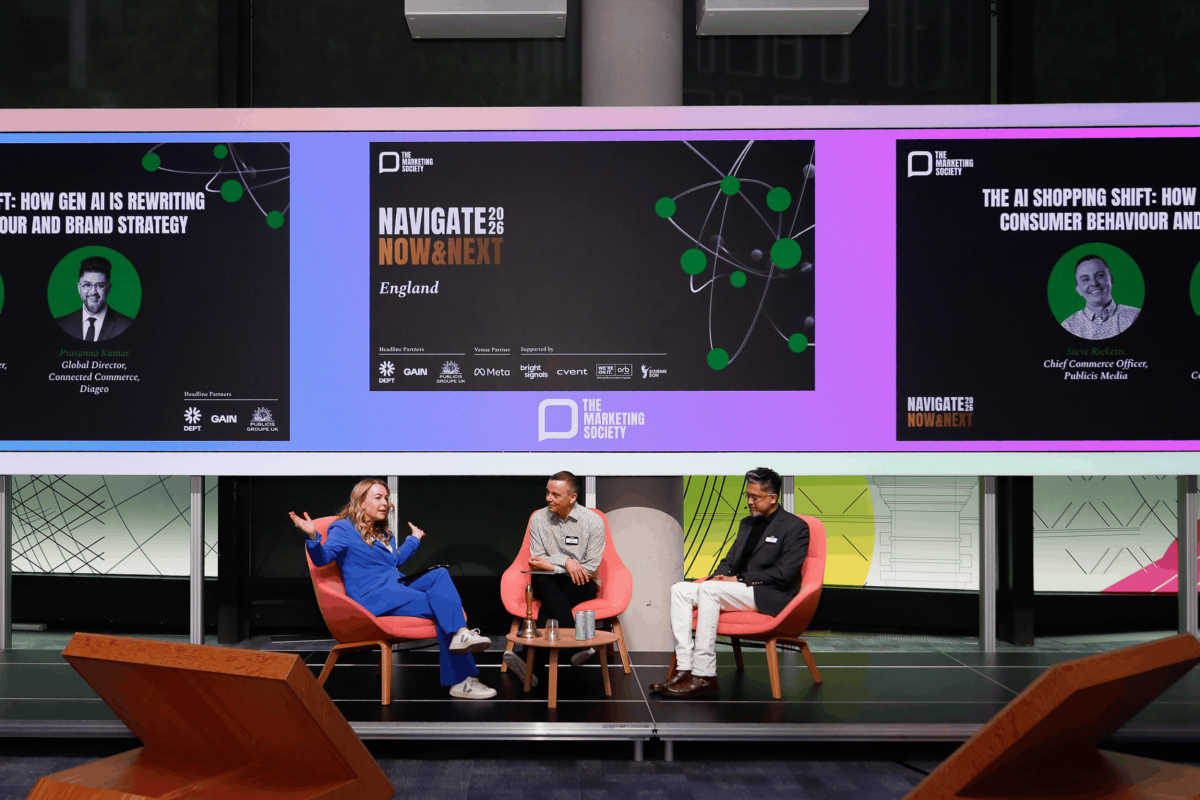
At a time when marketers are still debating the long-term implications of generative AI, consumers have already moved ahead. That was one of the clearest messages from a session featuring Publicis Media Chief Commerce Officer Steve Ricketts and Diageo’s Global Digital Commerce Experience Director (Pras) Prasanna Kumar at The Marketing Society’s Navigate Now and Next event in London 2026.
The discussion explored how AI is reshaping the shopping journey in real time, from discovery and consideration through to purchase, and what brands need to do to remain visible, understandable and ultimately chosen in an increasingly AI-mediated world.
Consumers Are Already Shopping with AI
Ricketts argued that one of the most significant behavioural changes is the shift from “keywords to conversations”, with consumers moving away from isolated search terms towards ongoing, contextual interactions with AI tools. He warned that brands now risk being “abstracted behind underlying consumer needs” as AI assistants increasingly become the interface between consumers and products. This is happening in LLMs like ChatGPT and retailers like Amazon Rufus.
Ricketts also stressed that marketers need to distinguish between two emerging behaviours: AI-assisted shopping and agentic shopping.
“There’s AI-assisted shopping, helping you through the journey from validation, or from discovery, from research and through to the purchase,” he said. “And then there’s agentic shopping, where you actually have an agent buy on your behalf.”
Drawing on Publicis Commerce’s How Shoppers Shop research, he highlighted the growing role AI is already playing in grocery shopping, a category traditionally slower to digitise. “Four in ten shoppers are already using generative AI in their shopping journey, and 88% of those users trust it,” he said. “Two in three AI users are switching brands in the aisle after using their phone, which is twice as much as people not using AI.”
The Rise of AI-Mediated Commerce
For Pras, the implications go far beyond search behaviour. He described AI as “compressing” what were once distinct stages of the path to purchase into a single moment of decision-making.
“AI is already becoming your first moment of truth,” he said. “If your brand is not showing up, you may not even be considered.”
Using Diageo’s ready-to-drink cocktail category as an example, Pras explained how consumers are no longer searching through traditional product terminology. Instead, they are prompting AI with contextual requests such as “a cocktail for a summer barbecue” or “something for a house party”, with AI interpreting those occasions and recommending products accordingly.
That shift, he argued, means brands need to rethink how products are described and structured online. “It’s no longer just about visibility,” Pras said. “It’s about whether your product is understandable by AI.”
From Findable to Choosable
The session also explored the emergence of retailer-owned AI assistants such as Amazon’s Rufus and Walmart’s Sparky, as well as the rise of “agentic commerce”, where AI tools begin making purchasing decisions on behalf of consumers.
While both speakers agreed that fully autonomous purchasing remains at an early stage, they argued that delegated decision-making is already happening. Pras pointed to three future requirements for brands: products must be “findable”, “recommendable” and ultimately “choosable” by AI agents.
The panel ended with a clear call for marketers to focus less on AI hype and more on understanding how behaviour is changing within their own categories.
“Consumers are ahead of a lot of businesses in their adoption of AI,” said Ricketts. “The key thing is understanding what’s happening in your category, then deciding what you’re going to do about it.”
Provided by Publicis Groupe UK, Partners for The Marketing Society Navigate Now & Next