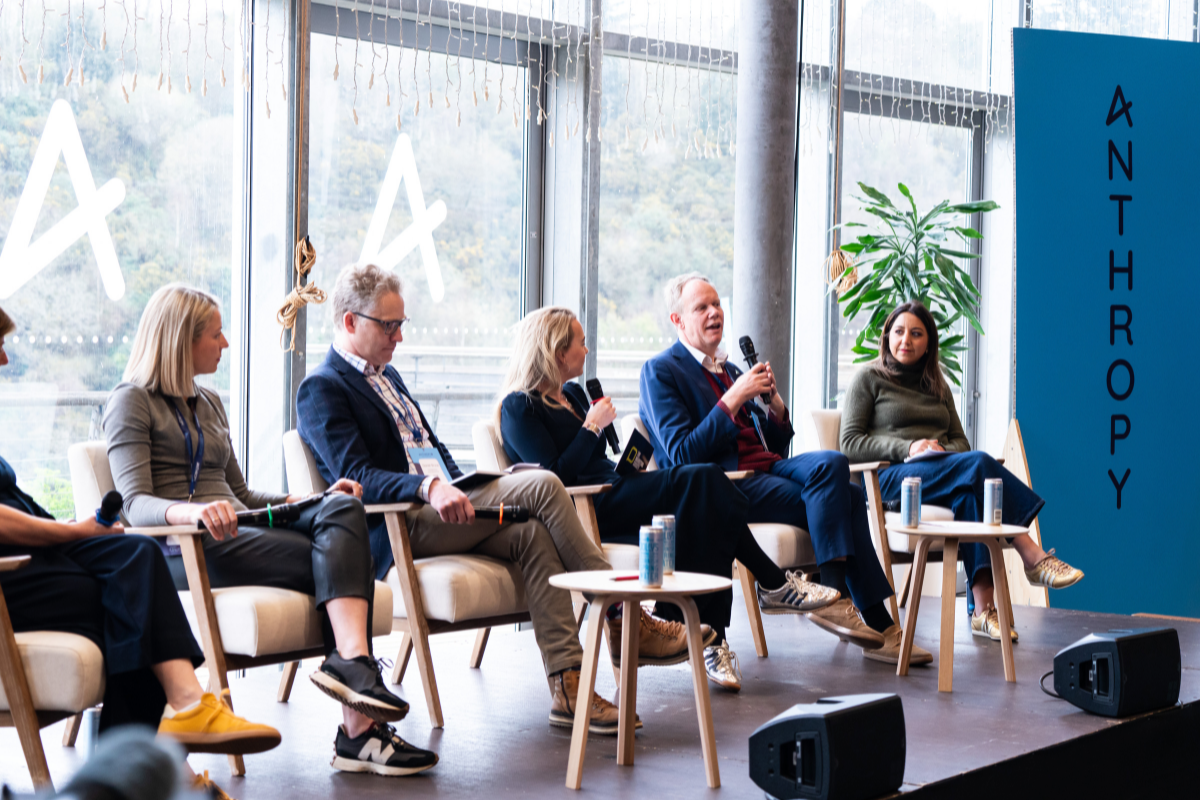
The Marketing Society's Rachel Letham spent three days at Anthropy 2026 in Cornwall, here are her key take outs from day two.
DAY 2 - THURSDAY 26 MARCH 2026
Uniting through Trust, Transparency and Public Good
This session featured Sophie Devonshire (The Marketing Society), Dame Melanie Dawes (Ofcom), Kelly Beaver (Ipsos), Sir Matthew Rycroft KCMG CBE (National Strategy Project), Zahra Bahrololoumi (Salesforce) and Daniel Bruce (Transparency International UK).
Five Key Insights
The UK’s trust deficit is not about technology - it’s about institutions
Kelly Beaver from Ipsos opened with a striking data point: two thirds of UK people are more worried than excited about AI, compared to half globally. The root cause is not technophobia. It correlates strongly with low trust in the ability of UK institutions to govern and regulate AI responsibly. Only four in ten Britons trust government to regulate AI well, compared to eight in ten in Singapore and Indonesia. The question is not whether the UK public are tech-savvy. It is whether they believe those building, deploying and governing technology are acting in their best interests.Regulation without delivery destroys trust faster than no regulation at all
Sir Matthew Rycroft’s sharpest point was that if a government gets a reputation for not delivering on what it promises, that is the single greatest killer of trust. The UK has arguably the most comprehensive online safety regulation in the world, yet public trust in those systems remains below average. The gap between the quality of what is being done and the public’s perception of it is a communications failure as much as a policy one.Responsible AI requires guardrails, grounded data and diverse teams - not good intentions
Zahra Bahrololoumi from Salesforce was the session’s most specific contributor on the mechanics of trustworthy AI. Salesforce processes eight trillion transactions daily and 800 million agentic work units per quarter. She gave concrete examples of AI going wrong and outlined the practical safeguards required: masking personal data, bias-checking training data as a routine habit, applying toxicity filters, maintaining full audit trails, and ensuring diverse teams are building and testing the systems. She closed with a powerful example of a young woman using AI to alert police to a domestic violence situation - an officer dispatched within nine minutes.Short termism in politics is structural, not a personality flaw
Sir Matthew’s reflection that the system itself is part of the problem was the most honest moment of the session. The electoral cycle actively discourages decisions that won’t pay off before the next election. The National Strategy Project’s response is to put agency back in the hands of people using technology to run genuine national conversations that feed into political accountability.Trust can rebound but only through consistent, delivered action
Kelly Beaver’s closing data point was the antidote to despair: trust in bankers, historically low after 2008, has risen steadily and now nearly half the UK public trust them. The rebuild is done through consistency, delivery and behaviour over time. Trust is rebuilt incrementally, by the same means it is broken one promise kept, one action delivered, one transparent decision at a time.“If a government gets a reputation for not delivering, that is the absolute killer of trust.”
Sir Matthew Rycroft
In Summary
This session tackled the specific and increasingly urgent intersection of data, digital tools and public trust. The UK public are more sceptical than most comparable nations, not because they dislike technology but because they have stopped believing their institutions will protect them. The panel drew a clear line between the quality of UK regulation, which is genuinely world-leading in some areas, and public confidence in that regulation, which lags badly.
“The antithesis of anxiety is action.”
Zahra Bahrololoumi Salesforce
Brand Purpose - A Discussion with Chief Marketing Officers
This session featured William Bosanko (Brandpie), Dr Sally Uren (Forum for the Future), Marshall Manson (FleishmanHillard UK), Anna Russell (People’s Postcode Lottery), Helen (Cloudfair), Sarah (Ipsos), Matt Joyce (Omnicom/DOS) and Rachel Letham (The Marketing Society).
Five Key Insights
Purpose is not a marketing campaign, it's a lens for decision-making
Three years ago at Anthropy, purpose was central to almost every conversation. This year it had dropped off the agenda, replaced by vocabulary around vision, strategy and coherence. The room’s consensus: this is partly a labelling problem. The concept of purpose - why an organisation exists and what it is here to do - remains as essential as ever. What has become damaged is the word itself.Purpose versus profit is a false choice - the data proves it
Dr Sally Uren from Forum for the Future brought the evidence. Lego, Passenger Clothing and PepsiCo all demonstrated that organisations with genuine clarity of purpose outcompete their markets. Passenger Clothing is growing faster than any competitor in a shrinking outdoor clothing market. PepsiCo restructured after realising it was not a drinks company but a sustainable agriculture company. The commercial benefit of clarity is real and measurable.You have to remove all the marketing language to get purpose into a boardroom
Marshall Manson from FleishmanHillard was the session’s most usefully sceptical voice: as a marketing concept, purpose is damaged. Boards roll their eyes. Anna Russell from People’s Postcode Lottery prefers to ask “what is our role in the world?” That small shift in language makes the conversation accessible to people who are not marketers.Purpose is most valuable as a risk management tool
A clear sense of purpose gives organisations a foundation for navigating issues that would otherwise feel paralysing. It becomes a filter, a permission structure and a protection. And when trust erodes, research by Echo Research shows the gap opens not just in reputation but on the balance sheet between market capitalisation and balance sheet value.Authenticity and delivery are the only things that rebuild trust in a purpose claim
The room kept returning to trust. You cannot state values and then fail to live by them. Dr Uren’s closing thought: a brand’s reputation is built on character as well as capability. You can recover from capability failures. Failures of character are harder to come back from. Purpose is what maintains character when pressure is highest.In Summary
This Chatham House-style CMO roundtable was the most candid conversation of the three days. The shared conclusion: purpose has suffered from overuse, misapplication and an association with campaigns that never connected to business reality. But the underlying idea - that organisations perform better when clear about what they exist to do - is not in question. The challenge is to rebuild the business case, strip the jargon, and get the argument to boards in the language they find credible.
“Purpose or profit is a complete false choice.”
Dr Sally Uren Forum for the Future
The Trust Tax - How AI is Silently Eroding Credibility and Emotional Connection
This session featured Cameron Veasey (FleishmanHillard), Preethi Sundaram (Attentive), Katie Carroll (LinkedIn) and Professor Elizabeth Stokoe (LSE).
Five Key Insights
The trust tax is real, and audiences feel it before they can name it
Professor Elizabeth Stokoe’s research into human conversation explains why AI-generated content feels “off”. Real human interaction is both highly systematic and entirely idiosyncratic - every utterance carries unique meaning that AI strips out. Audiences increasingly recognise the uncanny feeling, even when they cannot articulate it. On LinkedIn, Katie Carroll noted this has its own acronym: AI DR - if you couldn’t be bothered to write it, I’m not going to bother to read it.The problem in marketing is not speed, it is depth.
Preethi Sundaram reframed the AI temptation in marketing. Speed has never been the real problem. The problem has always been how to create something that genuinely changes the way an audience thinks. AI is being used to solve the wrong problem. When major brands faced backlash for AI-generated campaigns, the issue was not that they used AI. It was that they used AI to bypass the thinking, not to support it.The line between AI as a tool and AI as a replacement is drawn at human thinking
Preethi’s team at Attentive has an explicit AI policy. AI is used for data analysis, campaign performance, market identification and stress-testing arguments. It is not used for copywriting or customer-facing communications. If you are using AI to help you think better, that is a tool. If you are using AI so that you do not have to think at all, that is a replacement and audiences will feel the difference.Human connection has qualities that are fundamentally not replicable
Elizabeth Stokoe’s research on domestic violence calls to 999 demonstrated this vividly: a caller communicates an emergency through pacing, overlap and interruption patterns that could not be scripted or trained into an AI call-taker. Chatbots cannot do genuine self-disclosure, because they have no self to disclose. And LLMs are never rude, never angry, never idiosyncratic — missing the full register of human expression.The response to AI commoditising content is to do things AI cannot do
Smart marketing teams are already pivoting. Events, community marketing, corporate retreats, in-person connections — investment in all of these is rising as a direct response to AI. Not because teams have more budget, but because those are the things that cannot be replicated. Where is AI going to become more of a reputational risk than an aid to efficiency? That is the question every organisation now needs to answer.In Summary
The most practically useful session of the three days for anyone working in marketing or communications. The panel did not argue against AI — all three speakers use it in their daily work. The argument was about where the line is drawn and why. The trust tax is the cumulative erosion of credibility that happens when AI-generated content, deployed without genuine human thinking behind it, fills up feeds and inboxes. The session’s most memorable reframe: the issue was never that content took too long to produce. The issue was always whether it was good enough to change someone’s mind.
“Speed has never been the problem. The problem is how do we create something genuinely good — something that changes the way an audience thinks.”
Preethi Sundaram Attentive