
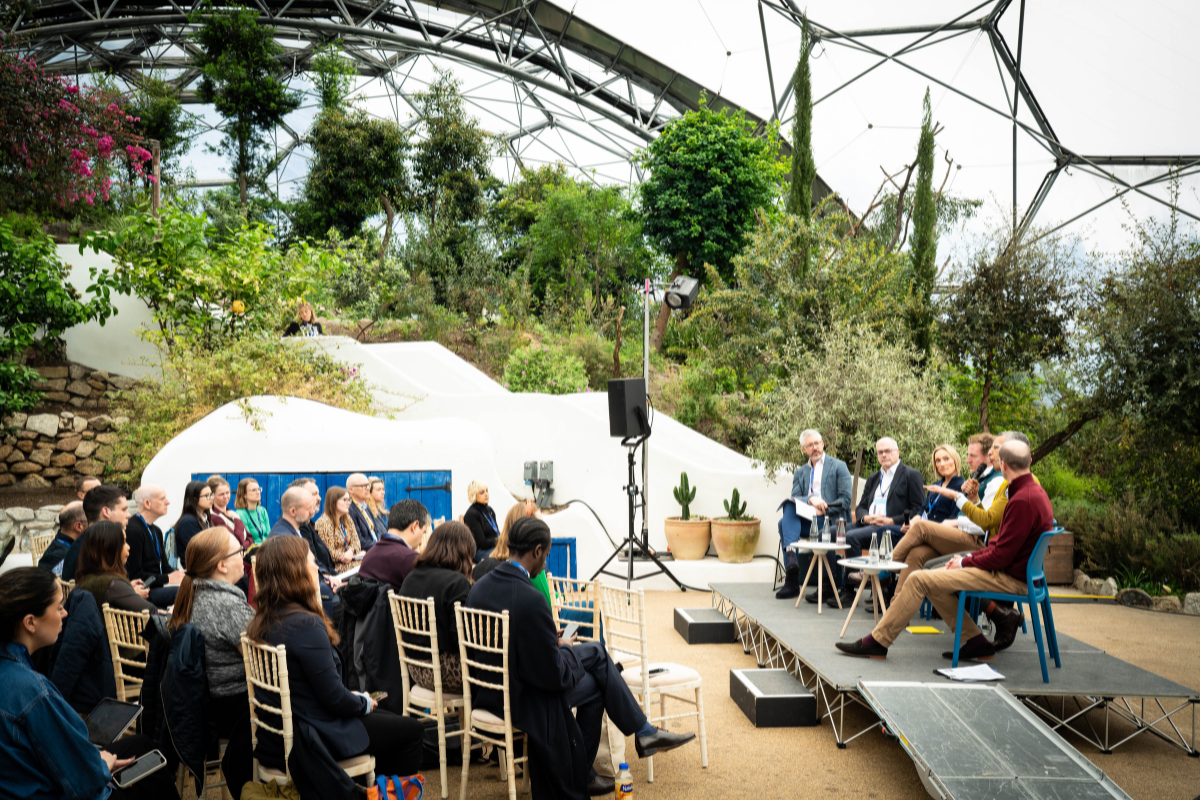
The Marketing Society's Rachel Letham spent three days at Anthropy 2026, here are her key take outs from the final day.
DAY 3 - FRIDAY 27 MARCH 2026
The Impact of AI on Employment and the Value of Being Human in the Workplace
This session featured Christian May (City AM, host), Kamal Ahmed (Fortune), Lord Matthew Elliott (The Jobs Foundation), Claire Cookson (Bloom Now.Me / Pathways Community), Ed Thompson (Salesforce) and Jimmy McLoughlin (Jimmy’s Jobs of the Future / Boxlight).
Five Key Insights
The youth employment crisis is the most urgent problem nobody is solving fast enough
Jimmy McLoughlin opened with a stat that should be on every government’s front page: almost a million 18 to 24 year olds are currently not in work or education in the UK. This is the generation that were 12 to 18 during the pandemic. The cost of employing someone entry-level now sits at around £30,000 once all obligations are factored in, making businesses reluctant to take a chance on someone learning the ropes. If the routes into work continue to disappear and are not replaced, this becomes a scar on the economy for the next 50 years. And if Dario Amodei’s estimate that 50% of white collar entry work goes in the next three to five years is even partially right, the impact on the tax base alone is enormous and almost entirely unconsidered.AI is brilliant at what humans are bad at and terrible at what humans are good at and education is teaching the wrong things
Claire Cookson’s contribution was the session’s most important. The World Economic Forum’s Education 4.0 framework maps the skills needed by 2030 and they are overwhelmingly human: grit, determination, relationship-building, adaptability, the mindset to keep learning. Meanwhile schools still reward rote learning and individual academic performance. Fifty-two percent of teachers’ time is currently spent on admin. Technology should be freeing teachers to do the profoundly human work of teaching. Children in studies consistently preferred human feedback over AI feedback, even when quality was equivalent. They want the human.Agentic AI is removing bureaucracy first and that is mostly a good thing
Ed Thompson from Salesforce was the session’s most grounding voice. Salesforce reduced a customer service team from 9,000 to 5,000 people and increased customer satisfaction. They then hired 8,000 sales people, because face-to-face human interaction is what the business actually needed more of. One client gave their entire customer service team a 30% pay rise after AI deflected half their interactions, because every remaining question required real skill. The jobs got better, not redundant. His headline: most companies are not doing anything yet, moving slowly and ill-informed which means the job apocalypse is not imminent, but the window to prepare is open and closing.The K-shaped economy is the real risk not mass unemployment
The panel’s most sobering thread was that AI will not destroy jobs equally. It will accelerate advantage for those with networks, contacts and access, while making it harder than ever for those without. The clear routes from entry-level to the boardroom are disappearing. Jimmy McLoughlin’s counter: community is the new entry-level. Running clubs, networks, shared interest groups the people who start or join communities are creating the career accelerants that used to come from grinding up through a corporate structure. There has never been a better time to build a career, but the routes are less visible than they were.Individual responsibility is not optional because politics will not move fast enough
Lord Matthew Elliott’s sharpest point: waiting for government regulation of AI is like watching a carthorse try to play a harpsichord. AI is already being used in military contexts to “shorten the kill chain” with no serious public debate. Rishi Sunak has argued that AI is as foundational as steam and electricity in the Industrial Revolution but will have twice the impact in half the time. The panel’s collective conclusion: this is an individual responsibility era. Skill yourself, build your networks, make conscious choices about how you use these tools because the institutions designed to protect people are operating years behind the reality.“AI is really good at replacing some things, but terrible at replacing others. And humans do want humans.”
Claire Cookson Bloom Now.Me / Pathways Community
In Summary
The most wide-ranging and at times urgent conversation of Anthropy26. The panel spanned employment policy, education reform, agentic AI deployment and the ethics of technological power. The underlying argument was not that AI will destroy work, but that the transition will be profoundly unequal unless deliberate action is taken at every level: in schools, in businesses, in policy and by individuals. Ed Thompson’s front-line pragmatism balanced Jimmy McLoughlin’s concern for young people entering a labour market with disappearing entry points, and Claire Cookson’s education perspective gave the whole conversation its most important grounding. The valued job of the future, it was said, is part artist, part engineer. The question is whether we are building a society ready to produce them.
“If entry level jobs are going, it’s the networks, the ways of learning and communities that need to exist in new and exciting places.”
Kamal Ahmed Fortune