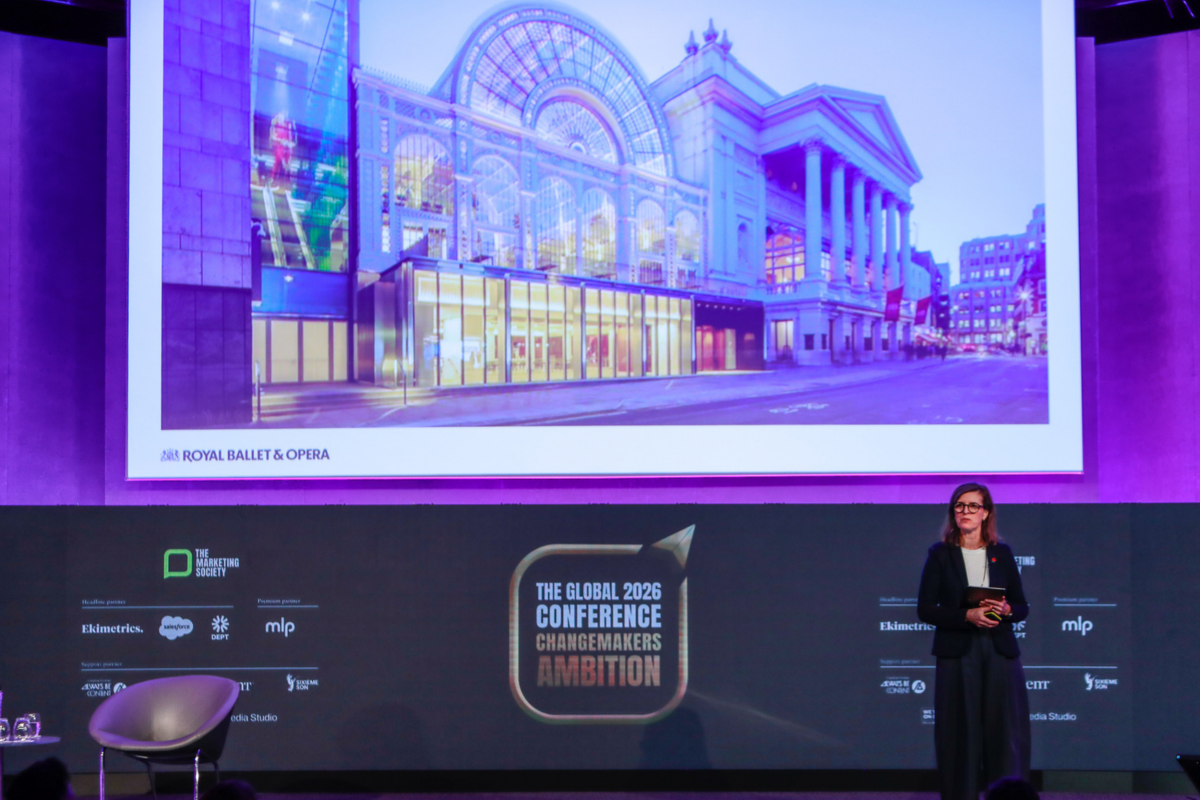
The Marketing Society's Changemakers Conference was full of ambitious people and ambitious stories, but the most important outcome was the energy we all came away with.
Events are on everyone's lips at the moment. After 20 years of digital explosion, a pandemic which pushed all our interactions onto a screen, and an artificial intelligence revolution promising to change everything all over again, the appeal of spending time with actual people in actual places is totally understandable. As more events appear, the law of averages sadly suggests that we're going to have to be even pickier if we're to avoid spending a day somewhere in the underwhelming middle of the bell curve.
What makes a great event goes beyond the content on the stage. Anyone who's been to a football match with a flat crowd, or watched a comedian battle a hostile audience knows that the people watching are as important as the people performing. Tough crowds are a thing. Which is why last week's Marketing Society Changemakers Conference was such an achievement. Again. Wall-to-wall content that was genuinely fascinating, useful or moving, delivered to a room full of people who were willing to get involved.
The Marketing Society Team, chapeau. But the thing I took away from the day went beyond the quality of the speakers and the crowd. Indeed, it went beyond what was said at all.
A different kind of ambition
The theme of the day was ambition and Sophie Devonshire was clear about what it didn't mean: more pressure, more deadlines, more things on already overflowing to-do lists (thank goodness!). Instead, she asked everyone to think about how they would complete a much more interesting sentence: I would love to...
What would you love to do? It's a very human question; which is appropriate, given that human has just been made 2026's word of the year. And as the year ends, we're all starting to look beyond the horizon of December 31st, and objectives are everywhere. What are the key initiatives? What's the number in the bottom-right box? What do we need in order to get there?
Objectives come with specificity and metrics. Ambition is more complicated. A mix of hope, belief, desire, direction and the determination to make something happen. Asking “what would you love to do?” frames those functional objectives with a human touch, and it was that human touch of ambition which ran through this year's conference.
Libby Jackson talked about becoming fascinated by space as a child and following that fascination all the way to Mission Control for the International Space Station. For anyone else trying to get back to the ambitions they had as an 8 year old it was a wonderful story to listen to. While none of us are going to space anytime soon, we could all learn from the examples Libby shared about the job of leaders being to listen, learn and decide; as opposed to needing to be the expert in the room at all times.
Major Scotty Mills' journey from a childhood in South London to leading the Royal Marines was powerful, more so for being shared on Armistice Day. Tales of military operations are always humbling; overcoming challenges that are genuinely existential, rather than `work stuff' which can only ever feel that way. Between Space and The Army the same idea shone through; that people can achieve amazing things when they believe in something, trust each other and are prepared to do the hard yards together.
Ambition in action: Yorkshire Tea and Center Parcs
It wasn't all metaphor and motivation (although I'm a sucker for both) and for those looking for great examples of ambition in action Simon Eyles took us through the story of Yorkshire Tea, who went from a challenger brand whose marketing department was viewed largely as a support function to a business led by belief in its brand and what it could become.
The platform, `Where everything's done proper', is more than just an advertising line. It was born from how the company actually makes tea, works with suppliers, looks after its people and approaches the way it does business. The marketing team's role in uncovering that was critical, followed through in Simon's words, by “lighting fires of belief around the business.” There were graphs and numbers too; “up and to the right” doesn't do them justice.
Sara Holt told the tale of her first months at Center Parcs, and the challenge of joining a business that was already extraordinarily successful. Rather than setting out to make better adverts, she went to the villages and spoke with the teams. She listened to the stories of what made family holidays special and the work which colleagues did to make them so. The resulting platform, `We build better worlds' is now something colleagues get behind, with implications for the product being sold, the experiences on offer and the commercial performance it all adds up to.
Tea, and holidays in the woods. Very British. And great examples of ambition reaching beyond marketing because the marketers took it there. That's the bit which often gets lost when we talk about ambitions for brand building. We know that brands grow through what people experience, remember and feel. We also know that businesses run on budgets, operational decisions and spreadsheets. Perhaps connecting those worlds is marketing's most ambitious objective? If so, Yorkshire Tea and Center Parcs show how it's possible.
Uncertainty, underneath it all
Along with ambition, another word kept resurfacing through the day, uncertainty. It's the context we were all living with when we came in, and The Marketing Society Chair, Jeff Dodds, returned to it in his closing remarks.
Neuroscientist Dr Hannah Critchlow explored what happens in our brains when the world doesn't behave as expected, and how having a high tolerance for uncertainty is going to be the thing which can really set us up for success. Which is good, because there's hardly been a shortage of uncertainty in recent years. We've all become familiar with things changing faster than we can comfortably make sense of them.
What was wonderful was that nobody seemed particularly frightened by it. Quite the opposite. There was a shared sense that uncertainty is something we'll work through, together. Hannah also encouraged us to daydream as a critical path to finding opportunities and the importance of imagination and creativity for our well-being as a species. As a way to access our ambitions in an uncertain world, that should be welcomed by us all.
That's not to say that artificial intelligence isn't extraordinary, or that technology won't transform our industry. It already is, and part of the uncertainty we need to accept is that we don't know how that transformation is going to unfold. Christina Boutrup's glimpse of the pace of change in China gave everyone an eye opening reminder of that.
So, a willingness to remain curious and tolerate ambiguity is critical to our success, and we all had opportunities to practice that throughout the day. I ended up hugging one man sitting next to me, and singing along with another. As if it was a perfectly normal thing to do. We all felt like it was.
Ambition you could feel in the room
Which brings me back to the event itself. The conversations over coffee. The willingness to ask one another for help. The slightly uncomfortable exercise of telling a stranger what you liked about them. James Sills somehow persuading hundreds of senior marketers to sing along together...All those ways of bringing ambition to life were part of what made the day work. Far from being a tough crowd the audience were brought into the content from the get-go.
And if you're a regular at The Marketing Society events, you know that sense of inclusion, connection and shared endeavour isn't anything new. Meet someone you don't know. Share something uncomfortable. Gather round and be ambitious together. Those are the interactions and experiences people have with The Marketing Society throughout the year.
I mention that, because we talk endlessly about brands being more than logos, products, websites and adverts. About the associations and feelings created through consistent and repeated experiences. And last week, brand-The Marketing-Society was on show. You could see it in the room, and you could feel it in the people. Which made the whole thing a rather good demonstration of the ambitious lesson the conference taught.
"Ambition isn't something that lives in a planning document or a spreadsheet, but in how people show up and the feelings that are left behind."
Of course we need objectives, budgets, processes and the commercial discipline to deliver them. Yorkshire Tea and Center Parcs were brilliant reminders of that. But targets don't make anybody ambitious. They don't create belief, build trust or change behaviour. People do.
Major Scotty Mills described how the Royal Marines make their values real, and he used a phrase which was both straightforward, and challenging. In front of a poster with the Marines' values writ large, he said:
“What we do, we take these words off a poster on the wall and we place them within people.” It's a brilliant ambition for marketing to pick up and run with.
We live in a world full of words. Of data. Of numbers and objectives. They are written on walls, they appear on screens, they are printed in documents. It is our job to take the objectives, hopes and aspirations of a business and turn them into something its people understand, believe in and act on. It is our job to take those ambitions and make them show up in the experiences of the customers who ultimately decide whether our businesses will succeed. We can write words on as many walls, slides and spreadsheets as we like. The real ambition is about placing them in people.
Onwards.