Growth is complicated for every brand, but nowhere is that puzzle more complex than for heritage brands. The equity that’s been built over decades, the distinctiveness, the loyalty - these are a heritage brand’s greatest asset and their biggest burden.
Over the years we've watched brilliant brands get it wrong. Stretching too far, compromising too much, and, as a consequence, losing the very fans who made them matter. How to properly navigate this tightrope is a question many of our clients sit with every day. So much so that we wanted to investigate and answer the question properly.
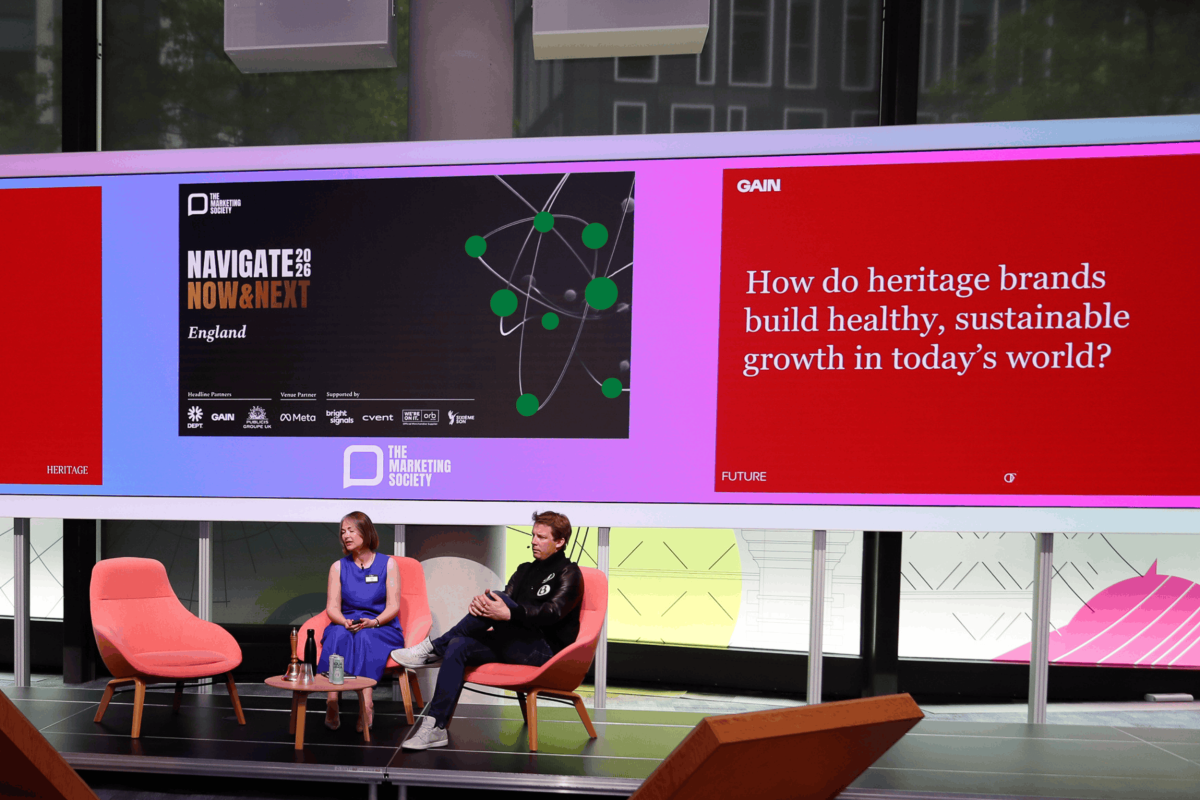
The findings of our subsequent report, The Future of Heritage, sat at the heart of our session at Navigate: Now & Next, where I discussed the findings with Ben Whattam, marketing director from Bentley Motors, and found many of the key themes within the report also surfaced throughout the day.
The Lloyds team's approach to experimentation, structured curiosity and evidence over instinct, mirrors what we'd argue heritage brands need most when they enter new spaces. Not boldness for its own sake, but the rigour to know what's worth trying and what isn't. Heritage brands often feel pressure to modernise quickly, but the strongest examples understand that evolution is not reinvention. Lloyds showed how experimentation works best when it is grounded in clear strategic intent rather than reactionary change. Small, compounding improvements, tested properly and scaled deliberately, are often far more powerful than chasing every cultural or technological shift all at once.
Isabel Perry's B2A session was a timely reminder that discoverability is no longer just a marketing question. As AI agents increasingly mediate discovery, recommendation and purchase decisions, brands face a very real risk of invisibility if they are not technically and structurally legible to these systems. But rather than simply focusing on optimising for AI infrastructure alone, we'd argue there is another layer to the opportunity, and heritage brands are uniquely placed to capitalise on it. The brands most protected in an AI-mediated future may ultimately be the ones consumers ask for by name before any agent gets the chance to decide. After all, nobody searches for the best wax jacket; they ask for the best wax jacket from Barbour. That level of cultural embedding, built patiently over decades through consistency, trust and distinctiveness, becomes an extraordinary commercial advantage in a world where algorithms increasingly shape attention.
Right now it's one of the most valuable things a brand can own.
The cultural conditions in this moment are more favourable for heritage brands than they might appear. 87.5% of consumers, skewing young, told us longevity matters more than
novelty when choosing a brand. We are now increasingly playing in a synthetic content environment, so genuine craft, provenance and authenticity are becoming increasingly valuable commodities. Uncertainty is making the familiar more valuable. However, to properly capitalise on this shift, heritage brands will need to spot the difference between a real opportunity and a distraction, and the rigour to know what must never change, and the courage to evolve everything else.
GAIN's Future of Heritage report is available now.
Nicky Smith, Strategy Director, GAIN