
Think piece

Shaping the Future with AI

insights from the Connection Circle

By Rachel Letham

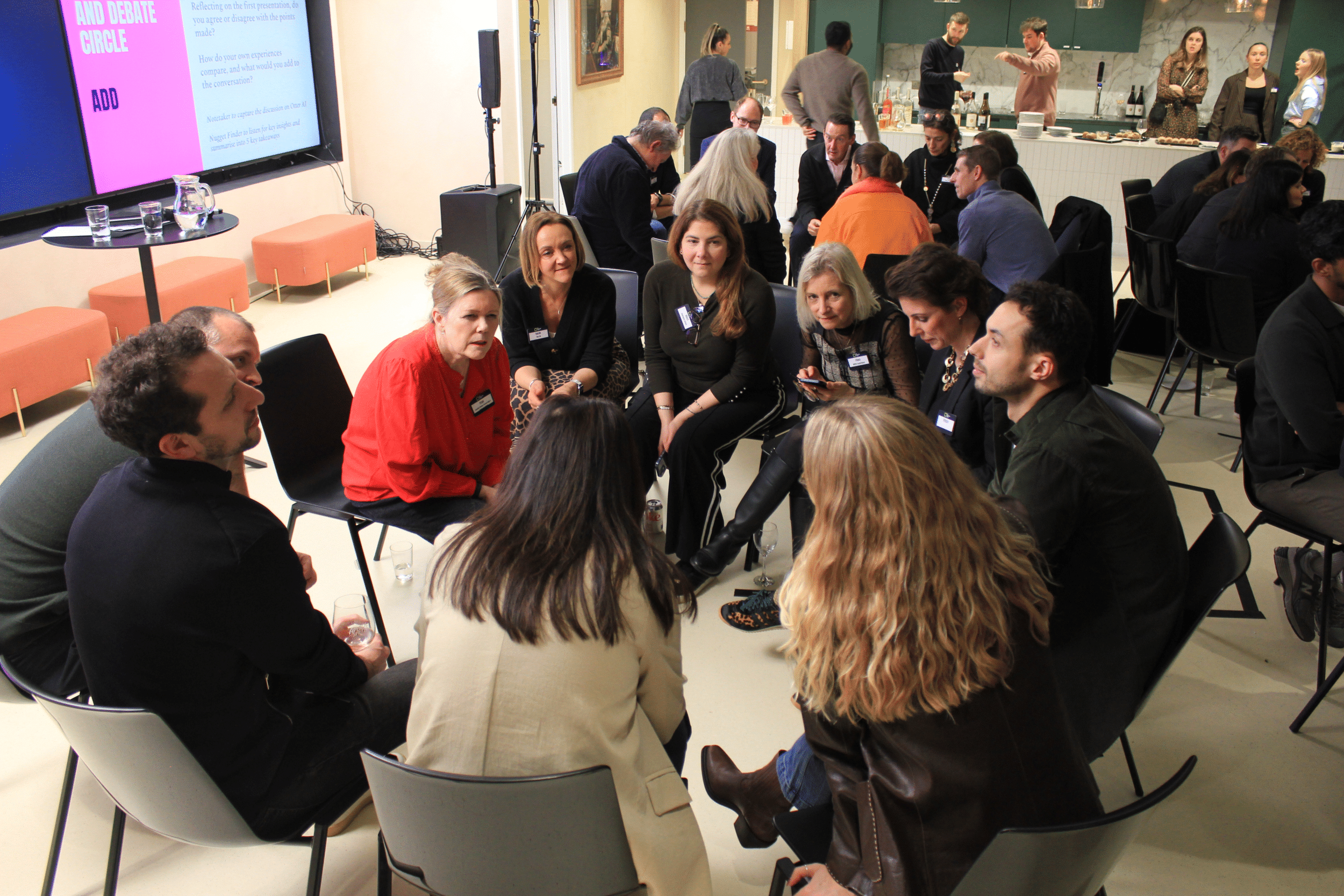
Member of The Marketing Society in a Connection Circle at an event

Three leaders shared their lived experiences of AI transformation in a new Pecha-Kucha style, offering practical insights on how marketers can lead organisational change. From Julie's hands-on product development at Patient.com, to Debora's strategic AI embedding across the enterprise at Unilever, to Sarah's rapid response to shifting search behaviour at the AA, each speaker proved that marketing expertise is uniquely positioned to guide businesses through the AI revolution. Their message was clear: this is marketing's moment to lead.

Featuring: Debora Koyama, Julie Doleman, Sarah Fuller


5 Key Points

Leaders Must Get Their Hands Dirty

You cannot delegate AI learning. Julie enrolled in a six-week Oxford programme, Debora spent time immersed in Silicon Valley taking two six-week leadership programs at Stanford, following a six-week program at MIT, and Sarah started experimenting with AI tools from day one. The only way to understand AI - where it excels brilliantly one moment and fails miserably the next - is through direct, daily use. Leaders who test AI first-hand can make better decisions about where to deploy it across their organisations.

Start With the Business Problem, Not the Technology

Julie's team identified a specific challenge: helping consumers navigate the complex administration of US healthcare. Sarah’s team tackled the challenge of fragmentation of search as LLMs began growing share. Both started with a clear problem before selecting AI as the solution. Debora reinforced this, urging leaders to map where AI can shift competitive advantage in their value chain rather than sprinkling it everywhere.

Marketing's Core Skills Are AI Leadership Skills

Responding to rapid consumer change, creating experiments, interpreting data, maintaining brand consistency across fragmented channels. These aren't new competencies, they're what marketers do every day. Sarah's work adapting to search ecosystem changes and Julie's focus on keeping humans in the loop both demonstrate how marketing expertise translates directly into AI programme success. Marketers understand consumers, insight, and business models, making them ideal lighthouses for entire organisations.

Creativity and Judgement Remain Irreplaceable

All three speakers emphasised that AI raises the baseline of quality but doesn't determine the ceiling. Sarah noted that great insight and judgement have no replacement. Debora argued that unlocking creativity, originality and taste will differentiate brands as everyone gains access to the same AI tools. Julie's team uses AI agents with constant human oversight from industry experts. Quality comes from human expertise shaping AI output, not from the AI itself.

Speed Requires Both Courage and Empathy

The pace of change is accelerating. Sarah's data showed 50% of global search volume could come from LLMs within 24 months. Her team improved electric vehicle visibility by four times in just two months. But speed needs to be balanced with care for people. Debora stressed that empathy is essential when teams fear being replaced. Julie brought AI experts inside the organisation so her team could learn alongside them, not watch from the sidelines.

Shaping the Future of AI

The evening opened with Julie sharing her 2025 New Year's resolution: learn what all the fuss was about AI. She enrolled in Oxford's six-week Business Leaders programme, expecting manageable content. She got six hours of weekly coursework, graded homework, and ultimately failed the course. But she also gained something more valuable: the foundation for her next career chapter.

Julie's key lesson came from her years running global innovation at Experian. Innovation isn't invention, it's taking something that exists and making it better. She applied this thinking to AI, refusing to outsource the work. She brought AI experts inside Patient.com to sit alongside her team, helping them solve a massive problem: navigating the US healthcare administration. The result was a conversational AI engine backed by an ecosystem of "frogs" (AI quality assurance robots) constantly sense-checking with human experts in the loop.

Her message was direct: The water is warm. Jump in. AI isn't the scary thing in this world.

Debora brought a different lens. As former Chief of Staff to Unilever’s CEOs, leading Corporate Strategy & Transformation, she led the company's C-level AI immersion in Silicon Valley two years ago. Meeting every major player shaping the AI revolution showed her how profoundly it would change business and work. She made AI central to Unilever's 2030 enterprise strategy, embedding it across six major bets, and personally deepened her expertise through programmes at MIT and Stanford.

Her conviction was that CMOs should be the lighthouse for entire organisations. Marketers know consumers and customers, and can translate the key insights into implications for the business and enterprise. They can demonstrate how AI can unlock value creation through both top and bottom lines. That's what CEOs and boards care about.

But Debora was clear about prerequisites. Leaders need strategy first. Map your value chain and identify where AI can shift competitive advantage. Don't just deploy it everywhere because you feel you should. Productivity gains are obvious. The bigger opportunity lies in unleashing creativity and originality, which requires human expertise and judgement. As everyone gains access to the same AI tools, taste and expertise become the differentiators.

She also emphasised empathy. Teams may fear replacement. Leaders need to help people see AI as a tool that amplifies their expertise rather than threatens their roles. This transformation is more about change management than technology.

From strategy to speed: what happens when the market shifts underneath you

Sarah offered a third dimension: real-time response to massive market shifts. She joined the AA in March 2025, just as AI moved from novelty to infrastructure. One of her first decisions was subscribing to Spotlight, a tool measuring brand visibility in LLM search. What she found was existential.

Search clicks are declining. In 24 months, 50% of global search volume is predicted to come from LLMs. The AA, with formidable competition from RAC and Green Flag, needed to respond fast. Sarah established measurement across visibility, volume and share. She discovered two-thirds of LLM citations come from off-site sources like Reddit and digital PR, not company websites.

Her team created a search ecosystem, bringing together content, PR and digital teams. They tested quickly. A bit of third-party content and advertorial improved electric vehicle visibility by four times in two months. The advice: get in fast. LLMs haven't yet worked out how to evaluate paid versus unpaid content.

Sarah's team also used AI to create 700 make and model pages in a month, deployed assist tool to reduce agency production time, and ran AI-optimised creative (despite some six-fingered executions along the way). By December, the AA launched an AI leadership programme for their top 200 leaders with Cambridge Judge Business School, creating cohorts working on groundbreaking projects.

Her reflection: marketing skills are AI leadership skills. Responding to consumer change, getting stuck in with experiments, working across the business with data and insight, giving teams skills and tools while maintaining brand consistency. These abilities sit in the marketer's wheelhouse.

All three speakers converged on similar themes; this is marketing's moment. The profession's core competencies translate directly into AI leadership but success requires personal commitment to learning, strategic thinking about where to deploy AI, courage to experiment quickly, and empathy for teams navigating change.

The question isn't whether marketers can lead. It's whether they will seize this opportunity before others do.

3 Take-aways

Use AI Every Day to Understand Its Limits

Don't delegate learning to your team or CTO. Personal fluency with AI tools helps you make better strategic decisions about deployment. Understanding where AI excels and fails only comes through direct experience. Leaders who test AI themselves can guide organisations more effectively.

Start With Strategy, Not Technology

Identify the specific business problem you're solving before reaching for AI as the solution. Map where AI can genuinely shift competitive advantage in your value chain. Quick wins matter, but they should ladder up to strategic priorities rather than being AI for AI's sake.

Keep Humans in the Loop for Quality

AI raises the baseline but doesn't set the ceiling. Human expertise, judgement and taste determine output quality. Build oversight systems that combine AI efficiency with human curation. Your team's domain knowledge is what transforms adequate AI results into exceptional outcomes.

2 Action Items

Experiment With AI on a Problem You Hate Solving

Choose one repetitive, time-consuming task in your work and use AI to solve it. Start small. Learn by doing. Share what you discover with colleagues. This builds personal fluency while identifying practical applications that free up time for higher-value work.

Map Your Organisation's AI Leadership Gap

Assess who currently owns AI strategy in your business. If marketing isn't at the table, identify the specific business problem where marketing expertise could guide AI deployment most effectively. Build your case around consumer insight, brand consistency, or growth opportunities.

 Debora Koyama

"I truly believe it is one of the most exciting times to be a CMO or a marketing leader in this age of AI."

Debora Koyama Former Chief of Staff to CEOs, Strategy & Transformation and Global Growth Operations Officer, Unilever