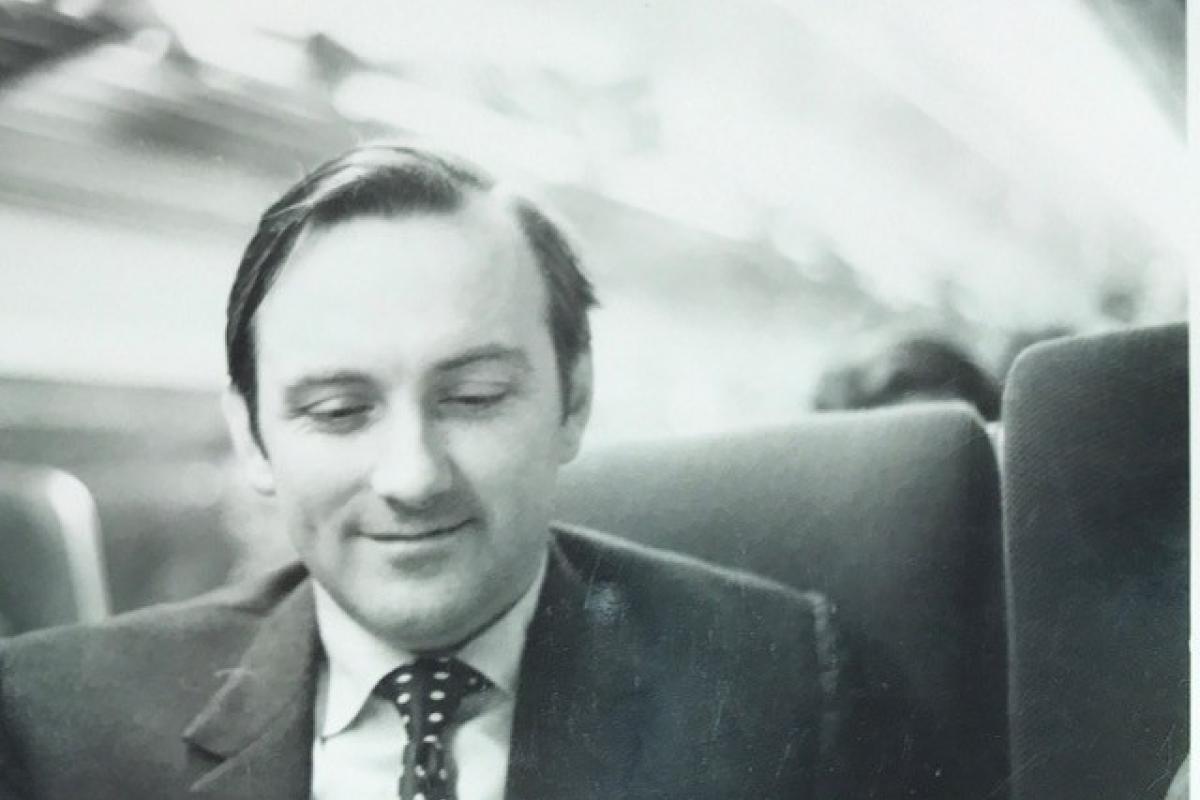
Tony Scouller, one of the Society’s much respected Honorary Fellows died recently. Former CEO of The Marketing Society Hugh Burkitt worked with him for many years, here he looks back on a colourful character with a long and successful marketing career.
A Big Name in Drinks Marketing
In the last two decades of the twentieth century Tony Scouller stood out as one of the big beasts in the dense jungle of drinks marketing. One sighting of him was likely to leave an impression of pomposity and even bombast, but those who worked with him, and for him, came to admire him greatly for his successes, his individuality and even his kindness.
Before exploring some of his eccentricities and re-telling some Scouller stories, we need to establish his achievements. Enoch Powell once observed morosely that all political careers end in failure, and this can often seem to be the fate of marketers. But when Tony left the newly formed Diageo, he had not only been one of the UK’s longest serving marketing directors, he had presided over the rise and rise of established premium brands like Smirnoff and Baileys, and the emergence of new stars like Jack Daniels, Malibu and Bombay Sapphire. There were also some shooting stars like Piat d’Or, which blazed brightly as UK wine brand leader in the mid eighties, before falling back to earth in the nineties. It was a golden period of growth in sales and profit that added huge value to the shares of IDV’s owner Grand Met, and allowed them to form Diageo by merging successfully as equal partners with United Distillers, who owned a more aristocratic but less dynamic portfolio of spirit brands.
Before joining IDV in 1983, Tony had spent sixteen years at J Walter Thompson, then the classiest advertising agency in London. There he had been schooled in the art of branding by a trinity of advertising gurus: Jeremy Bullmore, author and creative legend, Stephen King, planning’s founding father, and Judie Lannon, later The Marketing Society’s first editor. They were a key influence on his subsequent career and imbued in Tony an excellent set of values which to approach IDV’s diverse assembly of wine and spirit brands. Getting consumers to pay a premium price for a brand of doubtful provenance required stylish and thoughtful communication, and in those happy pre-digital days, television advertising was still the most powerful way to influence consumers. Tony himself was quite clear about his own limitations.
“I am not an original. I’m a user and a practitioner and I use the brains of others cleverer than me.”
Tony Scouller
In any big company there are always many contributors to a success, but the Tony I knew, always a well trained Thompson’s account representative at heart, knew the value of that wise political saying: “There is no limit to what can be achieved, if you are prepared to let someone else take the credit”.
The Man Behind the Act
Tony’s contemporaries rated him highly in three particular areas of management. His ability to get good advertising out of his agencies. His ability to recruit and build a team of marketers, who saw him almost as a father figure; and his skill in developing strong relationships with brand owners. Many of the brands which IDV sold in this era, like Jack Daniels and Disaronno Amaretto were owned by foreign companies, and advertising had to be developed that would not only build their brand in the UK, but would not offend their owners sometimes inaccurate prejudices about the way the British market worked.
When we first met, I was full of nervous anticipation because I was then the MD of Fletcher Shelton Delaney, a modest sized advertising agency at the wrong end of the New Kings Road and he was about to become the main man on my most important account. We were then handling Piat d’Or and Malibu for IDV. As he approached me across the car park at Harlow, I saw a tall man in a brown trilby hat dressed in country clothes as if for a day at the races (It was a Saturday and Chris Nadin the Marketing Manager of Piat d’Or had somewhat bizarrely filled the Harlow car park with gravel and got us all playing pétanque) but I was immediately reassured by Tony’s jovial manner, which signalled that he wanted to create a positive working relationship with us, and I was struck with how much he seemed to be like Willie Whitelaw, Margaret Thatcher’s older but ever-loyal deputy.
Tony’s style as a marketer was arguably an exercise in branding in itself. His daughter Susanna reminded me that Jeremy Bullmore said in a speech at Tony’s sixtieth birthday party: “There was no need for the creative department at JWT to imitate Tony being pompous, because he did it so much better himself”. Others have talked of a kind of “patrician charm” and his nickname at Thompson’s was, inevitably, “Public Scouller”.
To this day whenever I hear Justin in the Archers, I am reminded of Tony, and others have likened him to the actor Robert Hardy playing Siegfried, the owner of the veterinary practice in All Creatures Great and Small, again an older character who is a mentor to the show’s younger hero James Herriot. So there was a bit of an act going on, but behind this there was definitely a man who knew how to play the cards in the right order. Tony played bridge to a seriously high standard, and on one occasion amazed one of his colleagues by being able to recall the next morning exactly who had held what cards in every hand they had played the previous evening.
Tony’s apparent pomposity could also be helpful to those of us on the agency side, because he would at key points know when to make himself absolutely clear. He knew that any agency worth its salt would be prepared to argue for a campaign idea, even when it had not been initially well received and Tony was always prepared to listen to impassioned members of the creative department. Sometimes the debate would carry on over several meetings, but if Tony was not satisfied by the arguments he would eventually say “I am formally requesting the agency to come back with a new proposal,” and he would allow a sensible amount of time for us to do this.
Susanna also shared with me a short history of Tony’s career, which he wrote himself, which suggests that he liked the idea of his real self being hidden behind an actor’s exterior. Campaign magazine asked him in 1995 to take part in a feature where they analysed his handwriting, and this is what Tony wrote about it: “It was typical of him that he dashed off - in his notorious red ink - a quote from Lewis Carroll, “And if the sea is boiling hot , and whether pigs have wings”. Their graphology analyst, who never met him, wrote: “Multifaceted to a degree. To describe him fully would be an impossibility. He so resists being bracketed it gives me a headache. He is able to contain his reactions and rarely reveals his motivation”. Whatever one thinks of the accuracy of this method of character assessment, Tony obviously enjoyed the puzzle his handwriting presented.
The would be actor in Tony is also reflected in this story told me by Tony Mair, a colleague at IDV in the nineties: “I knew a kind man with an empathy he often hid. When I was a newish Sales Director, who in his view needed some help with public speaking, he took it upon himself to hire a room offsite, and armed with a tome containing the best known speeches by Winston Churchill, he had me recite them repeatedly until he was satisfied that that I had learned the importance of pace, pause, accentuation, silence, volume and more to be a better speaker. A kind and generous use of his time”.
The Art of Creative Deception
The job of nearly all IDV’s advertising at this time was to give their brands something they mostly conspicuously lacked: credibility or heritage or as some people liked to call it “credigree”. In other words our job was often to pretend that the brand was something that in truth it was not. So Piat d’Or was a wine the real French adored. It did have big sales in France, but mainly in those days to English day-trippers who went across to Calais to buy duty free booze. Malibu was a real Jamaican rum, when, in fact, it had been invented at York Gate and was now manufactured in Harlow. Archers Peach Schnapps was a real spirit of some sophistication and not just a sweet tasting liqueur for young women who didn’t like the taste of wine or beer. Southern Comfort was a proper American whiskey from the deep south and not just an easy way for drinkers who didn’t really like the taste of whiskey to look cool.
It was a game that Tony, the ace disguiser of his own intentions when playing cards, was very good at. And at times, he needed to play a cool hand as a diplomat to bring the brand owner along with our proposed deception. I particularly remember Tony having to face the horror stricken faces of the executives of Brown-Forman when they saw how we had executed our campaign line: “Southerners have their own rules”. We thought we were enhancing the premium value and pedigree of Southern Comfort by bringing to life a cool bunch residents of the New Orleans region, shot in arty black and white by the then fashionable director Frank Budgen. Brown-Forman though we were dragging their brand down by associating it with what Hilary Clinton might have called “deplorables”. But Tony somehow kept the owners in the room and the show on the road. The research among the UK target was positive, the campaign ran, and for a while at least the brand’s sales turned upwards.
Before Marketing - Dentistry, the Army and Beecham's
One of the more curious facts about Tony is that following school and two year’s of National Service, he began a course at Guy’s Hospital to become a dentist. There are those who think that Tony would have been to dentistry what Sweeney Todd was to hairdressing, and fortunately he decided quite early on that filling cavities was not for him, though he would surely have been a bold extractor of teeth. Through a family connection he was interviewed by a senior executive at Beecham’s (then considered quite a sophisticated marketing company) who sucked on his pipe, told Tony he didn’t believe in interviews and invited him to start on Monday as the assistant to the display manager in the soft drinks department. A few years later Tony was the marketing manager on their two main brands Lucozade and Ribena, and perhaps his ability to rise swiftly through the ranks was partly a consequence of having been selected for officer training while on National Service.
Tony recalled his key learning as an army officer at his eightieth birthday party, when he passed on the advice he had been given on what to do whenever he encountered any members of the lower ranks. There were just two things you needed to say: “I wonder if you could put me in the picture?”, and “Carry on”. It seems to have been a recipe that worked remarkably well with many of his subordinates in business. There have been many fond tributes to Tony from marketers who worked for him. Jonathan Stordy wrote: “I was his Smirnoff marketing manager in the mid nineties and we were working with Lowe Howard-Spink to develop new “through the bottle” executions. One night he was leaving for the car park and turned sharply towards me to say: “Jonathan, where are the new Smirnoff executions?”. Hearing me mumble some feeble excuse he immediately replied: “Who is the marketing manager?” and left abruptly. That is how he got us to grow. Making it crystal clear it was our responsibility to deliver”.
He also recalls the valuable advice Tony gave on how to approach the board: “Get out of the board room as soon as you have got what you wanted, and for God’s sake don’t answer any questions you haven’t been asked”.
“Tony invented diversity before diversity existed as a thing. Your origin, gender or personality did not matter at all. Tony was only interested in potential and dozens of people went on to have good careers because of him.” Jonathan Stordy
One of those was The Marketing Society’s own Scotland supremo of many years Graeme Atha, who recalls: “Joining IDV in the eighties was for me like joining the Champions League. As a young Scotsman I found Tony’s style was initially quite difficult and at times he seemed to be parodying himself, but I grew to like and admire him, particularly for his judgement of advertising”.
JWT, Three Continents and the Enzyme Wars
That judgement had been honed during his JWT years when Tony had worked on some very big and busy brands across three continents. In London he found himself in the middle of the “Enzyme Wars” as Unilever tried to counter P&G’s hugely successful launch of Ariel with its own new brand Radiant. In New York he worked on the PANAM account when they were announcing the arrival of a new era in jet travel with the Boeing 747, and then on Kodak when they launched the Pocket Instamatic. In Venezuela he was invited to take over the Unilever account and as OPEC oil riches poured in he said he “watched with dismay the origin of the ghastly mess that the country is in now as a result of socialism run riot”.
Racing, Opera and Loyalty
Tony was brought up in Banstead within walking distance of the Epsom Downs and the famous racecourse, and throughout his life horse racing was perhaps his greatest enthusiasm. I took a polite interest in racing but he knew I was not of the brethren unlike his colleagues Colin Gordon and Ben Sear who both became members of the Royal Enclosure thanks to him. Colin was there at the peak of Tony’s career as a race follower when a horse called Motivator owned by a syndicate called The Royal Ascot Racing Club won the Derby.
As Tony was one of around 200 members of that syndicate his excitement at watching Motivator cruise home five lengths ahead of its nearest rival was so overwhelming that Tony leapt from his seat, and dragging Colin with him, sped towards the Winners Enclosure, where the traditional silver cup was to be presented. Entrance to the enclosure was not surprisingly barred by a policeman, but when challenged Tony pronounced: “I am the winning owner” and swept past him. There is no record of him actually receiving the trophy from Her Majesty The Queen, but nor did he get ejected.
In a long life of nearly ninety years Tony was very consistent in his style and his enthusiasms. Loyalty was an important aspect of his character and the turn out of former colleagues at IDV at his recent funeral was a testimony to the affection that this produced in return. As well as many of his former marketing team I noted three former bosses, Howard Smith, Colin Gordon and Roy Spence. A fourth, James Espey, who originally recruited him wrote me a note fro South Africa saying how effective he thought their working relationship had been “once we established how it would work”.
I was not the only advertising agency partner to benefit from this loyalty and his preference for developing a long term and consistent working relationship with his agencies. He liked to have a strong leader on the other side of the table at the important moments of decision, and in the nineties, during what he described as his most enjoyable years, he had Clive Holland to talk to at Young and Rubicam and David Wheldon at Lowes. He was not keen on switching brands around unless there was some international edict and if a pitch was deemed necessary he preferred to have it among his existing agencies.
This worked to my particular advantage in 1986 when the agency I ran, Fletcher Shelton Delaney, was threatened with being merged into its US owner in London, Ted Bates, just as Charles and Maurice Saatchi were about to make the fatal mistake of buying the vast and crumbling Bates empire. Not fancying being lost in this new wilderness, my creative director, Len Weinreich and I decided we would leave in a bid to remain independent. On sharing this problem with Tony he was quite clear: “I don’t want my account being carried round London in a briefcase”. But if we legally bought our existing agency and renamed it that would be fine. And after some tense negotiations with Bates and Saatchis we did just that, and we continued working on Baileys, Malibu and Piat d’Or as Burkitt Weinreich Bryant.
Although I was neither a bridge player nor a racing enthusiast, we both enjoyed opera and made regular trips to Glyndebourne which continued long after Tony retired. Going to the opera allowed me to get to know a little both Barbara his first wife of nearly forty years and Joan his second wife. Had they not both shared Tony’s enthusiasm for singing and racing, I think that being married to Tony would have been a fairly tough gig, but happily both Barbara and Joan enjoyed the opera, and they supported Tony’s socialising with splendid picnics. Barbara had originally also been a member of the marketing department at Beecham’s and Tony had romantically proposed to her one day on the District Line. Sadly, Barbara died just as Tony was retiring in 2001, but a few years later another of Tony’s marketing team fans, Nicolotte Robinson noted that one of her work colleagues had a widowed mother and she introduced Tony to Joan and they were then married for nearly twenty years.
Market researchers will tell you that we all have a tendency to look back on the past as some sort of golden age when the reality may actually have been somewhat different, but there is a very consistent theme when talking to people about working with Tony. Everyone remembers a happy time. Noël Coward once observed that, “Work is more fun than fun”, and working with Tony was certainly that. They were indeed happy days.
Anthony Scouller 1936 - 2026